
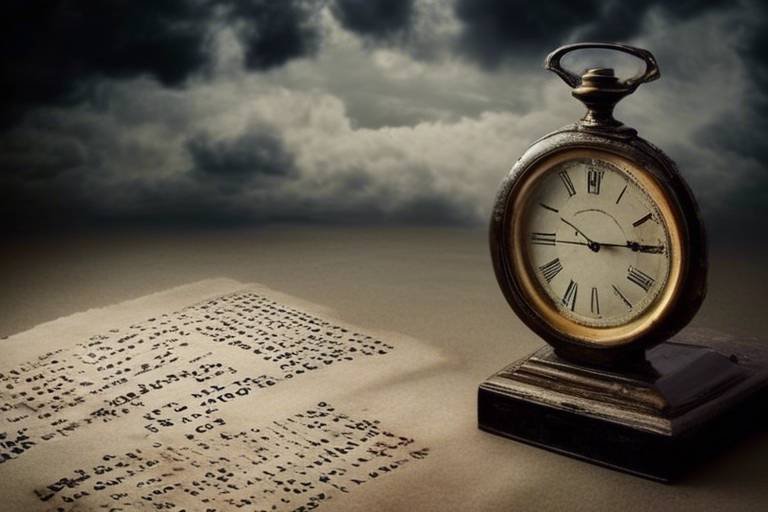
Time is one of those intriguing concepts that seems simple on the surface, yet dives deep into the abyss of philosophical inquiry. Have you ever stopped to ponder what time really is? Is it merely a sequence of events, or does it hold a deeper significance in our lives? The nature of time has perplexed thinkers for centuries, leading to a myriad of interpretations that shape our understanding of existence itself. In this exploration, we will unravel the complex tapestry of time, examining its philosophical implications, cultural perspectives, and scientific understandings.
When we think about time, we often categorize it into three distinct segments: the past, the present, and the future. But what if these categories are not as clear-cut as we believe? Philosophers like Henri Bergson argued that time is not just a measurement of moments but a fluid experience that is deeply intertwined with our consciousness. This perspective challenges the conventional view of time as a linear progression, suggesting instead that our perception of time can be subjective and influenced by our emotional states. For instance, have you ever noticed how time seems to fly when you’re having fun, yet drags on during a boring lecture? This subjective experience raises questions about the very fabric of reality and our place within it.
Our understanding of time significantly influences our perception of reality. Imagine time as a canvas on which the universe paints its story. If we perceive time as linear, we might view our lives as a series of events leading to a predetermined outcome. On the other hand, if we adopt a cyclical view, we might see existence as a series of recurring patterns, where past experiences inform future actions. This distinction has profound implications for how we interpret our existence and the universe around us. Are we mere spectators in a grand cosmic play, or do we have the power to shape our destinies?
In exploring the differences between linear and cyclical models of time, we uncover a rich tapestry of cultural and philosophical interpretations. Linear time is often associated with Western thought, where time is viewed as a straight line leading from the past through the present and into the future. This perspective fosters a sense of progress and development but can also lead to a deterministic outlook, where everything feels preordained. Conversely, cyclical time, prevalent in many Eastern philosophies, suggests that time is a repeating cycle, akin to the seasons. This view promotes a sense of renewal and continuity, emphasizing the interconnectedness of all things.
The choice between a linear or cyclical view of time carries significant philosophical ramifications. For instance, if we embrace a linear perspective, we may grapple with questions of determinism and free will. Are our choices truly our own, or are they simply the result of a predetermined sequence of events? On the flip side, a cyclical view might lead us to contemplate the nature of change and the possibility of rebirth. These philosophical dilemmas are not just academic exercises; they shape our beliefs, actions, and ultimately, our realities.
Different cultures have distinct interpretations of time, which profoundly affect their worldviews. For example:
- In Western cultures, time is often viewed as a commodity, leading to a fast-paced lifestyle where efficiency is prized.
- In contrast, many Indigenous cultures perceive time as a communal experience, where the past, present, and future are interconnected.
- Eastern philosophies, such as Buddhism, emphasize the cyclical nature of time, encouraging mindfulness and presence in the moment.
These varying perspectives highlight how our cultural backgrounds shape our understanding of time and existence.
Time perception is a fascinating aspect of human experience. Psychologically, our brains process time in ways that can differ dramatically from one individual to another. Factors such as age, emotional state, and even cultural background can influence how we perceive the passage of time. For instance, children often experience time more slowly than adults, likely due to their novel experiences. This raises an intriguing question: if our perception of time is malleable, what does that say about the nature of reality itself? Could it be that time is not a fixed entity but rather a fluid construct shaped by our consciousness?
As we transition from philosophy to science, the understanding of time becomes even more complex. Physics has challenged traditional notions of time, offering theories that reshape our comprehension of existence. One of the most groundbreaking theories is Einstein’s theory of relativity, which fundamentally altered our perspective on time and space. According to this theory, time is not an absolute constant; it can stretch and compress depending on speed and gravity. This revelation leads us to the concept of time dilation, where time moves slower in stronger gravitational fields or at higher speeds.
Imagine two twins: one stays on Earth while the other travels through space at near-light speed. When the traveling twin returns, they will be younger than their sibling. This mind-boggling phenomenon illustrates how time is not a universal constant but a relative experience. Such insights challenge our intuitive notions of time, forcing us to reconsider our understanding of reality itself.
Quantum mechanics adds yet another layer of complexity to our understanding of time. Concepts like superposition and entanglement challenge the classical view of time as a linear progression. In the quantum realm, particles can exist in multiple states simultaneously, and their behaviors can be interconnected across vast distances. This suggests that time might not be as straightforward as we once believed. Instead, it could be a multifaceted dimension that intertwines with the very fabric of reality.
- What is the philosophical definition of time? Time is often viewed as a continuum that allows for the ordering of events, but its true essence is debated among philosophers.
- How does culture influence our perception of time? Different cultures have various interpretations of time, affecting how individuals experience and prioritize it.
- What is time dilation? Time dilation is a phenomenon predicted by Einstein’s theory of relativity, where time moves slower in stronger gravitational fields or at higher speeds.
- How does quantum mechanics challenge our understanding of time? Quantum mechanics introduces concepts that suggest time may not be linear and can be affected by the interactions of particles.
The Nature of Time
Time is one of those fascinating concepts that seems to slip through our fingers like sand. It’s something we all experience, yet it remains an enigma wrapped in layers of philosophical inquiry. Have you ever wondered what time really is? Is it merely a sequence of events, a measurement of change, or something more profound? The nature of time has intrigued philosophers, scientists, and thinkers for centuries, leading to a myriad of interpretations that challenge our understanding of existence itself.
At its core, time can be seen as a framework that helps us make sense of our experiences. We often think of it in terms of past, present, and future. The past is a collection of memories and events that have shaped who we are, while the present is our fleeting experience of now. The future, on the other hand, is a realm of possibilities waiting to unfold. But what if our perception of these temporal stages is just a construct? What if time is an illusion, a mere byproduct of our consciousness?
Philosophers like Immanuel Kant argued that time is not an inherent property of the universe but rather a way our minds organize experiences. This perspective suggests that time is subjective, varying from one individual to another. For instance, have you ever noticed how time seems to fly when you’re having fun but drags on during a boring lecture? This subjective experience of time can be influenced by various factors, including emotions, age, and even culture.
To further complicate matters, consider the notion of time as a dimension. Just as we navigate through three-dimensional space, some theorists propose that time is the fourth dimension, interwoven with the fabric of the universe. This perspective raises intriguing questions about the nature of reality. If time is a dimension, can we move through it like we do through space? Are past events still “there,” just in a different temporal location?
In many cultures, time is perceived differently. For example, in Western societies, time is often viewed as linear, a straight path from past to future. This linear perspective emphasizes progress and achievement, shaping our approaches to life and work. Conversely, many Eastern philosophies view time as cyclical, akin to the seasons or the cycles of life and death. This cyclical understanding fosters a sense of harmony and interconnectedness with the universe, suggesting that events are part of a larger, eternal rhythm.
Ultimately, grappling with the nature of time invites us to question our existence and our place within the universe. Are we mere spectators in a grand cosmic play, or do we have agency in shaping our temporal reality? As we ponder these questions, we find ourselves at the intersection of philosophy, science, and personal experience, each offering its own lens through which to view the elusive concept of time.
- What is time? Time is often defined as a measurable period during which events occur, but its true nature is a subject of philosophical debate.
- Is time an illusion? Some philosophers argue that time is a construct of human perception rather than an objective reality.
- How does culture influence our perception of time? Different cultures may view time as linear or cyclical, affecting their worldviews and approaches to life.
- Can we travel through time? While time travel remains a popular concept in science fiction, current scientific understanding does not support the feasibility of moving through time as we do through space.
Time and Reality
When we think about time, it’s hard not to wonder how it intertwines with our understanding of reality. Time is not just a ticking clock or a calendar filled with dates; it is the very fabric that weaves together our experiences, memories, and aspirations. Imagine time as a vast river, flowing continuously, carrying us along its currents. Each moment is a droplet, unique yet part of a larger stream. But what does this mean for our perception of existence? How does our understanding of time shape the way we see ourselves and the universe around us?
The relationship between time and reality is a complex one. On one hand, we have our subjective experience of time, which can feel elastic—sometimes stretching, sometimes compressing depending on our circumstances. For instance, have you ever noticed how time seems to fly when you’re having fun, yet drags on during a dull meeting? This subjective perception can significantly influence our reality. The way we perceive time can alter our emotions, decisions, and ultimately, our experiences.
Moreover, our understanding of time can impact how we interpret the universe. In a linear perspective, time is seen as a straight path, moving from past to future. This view aligns with the idea of cause and effect, where every action has a consequence. In contrast, a cyclical view of time suggests that events are repetitive and interconnected, like the seasons that return year after year. This can lead to a more holistic understanding of existence, where everything is part of a larger cycle, continuously evolving but never truly lost.
To illustrate this further, consider the following table that summarizes the key differences between linear and cyclical perspectives of time:
| Aspect | Linear Time | Cyclical Time |
|---|---|---|
| Nature of Time | One-dimensional, moving forward | Multi-dimensional, repeating cycles |
| Perception of Change | Change is progressive and irreversible | Change is part of a cycle, can be reversible |
| Philosophical Implications | Supports determinism and linear causality | Encourages notions of rebirth and renewal |
So, how does this all tie back to our reality? Well, if we adopt a linear perspective, we might feel a sense of urgency to achieve our goals, as time is always moving forward and never returns. This can lead to stress and anxiety, especially if we feel we’re falling behind. On the other hand, embracing a cyclical view can foster a sense of peace and acceptance, as we recognize that life is a series of cycles—birth, growth, decay, and rebirth. This perspective can help us appreciate the present moment, understanding that while we may face challenges, they are part of a larger pattern of existence.
Ultimately, our perception of time shapes our reality in profound ways. It influences not just how we experience our lives but also how we relate to one another and the world. Understanding this intricate relationship can empower us to navigate our lives with greater awareness and intention. So, the next time you glance at the clock or flip the page of your calendar, take a moment to ponder: how does time influence your reality?
- What is the difference between linear and cyclical time?
Linear time is viewed as a straight path from past to future, while cyclical time sees events as repeating cycles. - How does our perception of time affect our emotions?
Our perception can influence feelings of urgency or relaxation, depending on whether we view time as a finite resource or part of a continuous cycle. - Can changing our perspective on time impact our lives?
Yes, adopting a different view on time can lead to changes in how we approach goals, relationships, and personal growth.
Linear vs. Cyclical Time
When we think about time, two distinct models often come to mind: linear and cyclical. Imagine time as a river; in the linear model, it flows in one direction, from the past, through the present, and into the future. This perspective is deeply embedded in Western thought, where time is often seen as a straight line leading to a destination. In contrast, the cyclical model views time more like the seasons: a continuous loop where events repeat and life is seen as a series of cycles. This can be likened to the rhythm of nature, where everything from the changing of the leaves to the cycle of the moon reflects a recurring pattern.
The implications of these two views are profound. In a linear understanding, every moment is unique, and the future is something to be conquered or achieved. This can lead to a sense of urgency and the pressure to make the most of every fleeting second. On the other hand, the cyclical perspective offers a sense of comfort and continuity, suggesting that life is not just about moving forward but also about returning and reflecting. It invites us to embrace the present as part of a larger tapestry of existence, where beginnings and endings are intertwined.
Different cultures embody these concepts in various ways. For instance, in many Indigenous cultures, time is viewed cyclically, with a deep respect for the natural rhythms of life. This can be seen in their practices and rituals that honor the earth and its cycles. Conversely, in modern capitalist societies, the linear model often dominates, driving people to prioritize productivity and progress over reflection and connection. This difference can lead to contrasting worldviews, where one sees time as a valuable resource to be managed, while the other sees it as a sacred rhythm to be honored.
Ultimately, the debate between linear and cyclical time is not just an academic exercise; it shapes our very understanding of existence. Consider how you approach your own life. Do you see time as a race to the finish line, or do you find value in the cycles of your experiences? By exploring these perspectives, we can gain deeper insights into our own beliefs and the cultural narratives that influence us. It’s a fascinating journey, one that invites us to ponder not just how we measure time, but how we truly experience it.
- What is the main difference between linear and cyclical time?
Linear time is perceived as a straight line with a clear beginning and end, while cyclical time is viewed as a repeating loop or cycle. - How do cultural perspectives influence our understanding of time?
Different cultures may prioritize one model over the other, affecting their rituals, practices, and overall worldview. - Can we blend both perspectives of time in our lives?
Yes, many people find value in recognizing the urgency of linear time while also appreciating the cyclical nature of life, allowing for a balanced approach.
Philosophical Implications
The way we understand time has profound philosophical implications that ripple through our notions of existence, free will, and the nature of change. When we consider time as a linear progression—where the past is fixed, the present is fleeting, and the future is yet to be written—we often find ourselves grappling with the concept of determinism. This perspective suggests that every event is causally determined by preceding events, leading us to ponder: Are we merely puppets dancing to the strings of fate? Or do we possess the freedom to choose our paths, regardless of the timeline laid out before us?
On the flip side, viewing time as cyclical can radically alter our perception of existence. In many Eastern philosophies, time is seen as a repeating cycle, much like the seasons. This perspective lends itself to the idea of rebirth and renewal, where every ending is merely a precursor to a new beginning. Here, the implications of free will shift; instead of a straight line leading to a singular destination, life becomes a series of loops, allowing for multiple opportunities for growth and change. This cyclical view can foster a sense of comfort, as it implies that mistakes can be rectified in future iterations of existence.
To illustrate these philosophical implications, let’s consider a table that contrasts the two views:
| Aspect | Linear Time | Cyclical Time |
|---|---|---|
| Nature of Existence | One-way progression | Endless cycles |
| Free Will | Limited by past events | Opportunities for renewal |
| Change | Linear and often irreversible | Transformative and regenerative |
These contrasting views not only shape individual beliefs but also influence entire cultures. For instance, cultures that embrace a linear view of time often prioritize progress, innovation, and a forward-thinking mindset. In contrast, those that adopt a cyclical view may focus on harmony, balance, and the interconnectedness of all things.
In conclusion, the philosophical implications of our understanding of time are vast and complex. They challenge us to reflect on our beliefs about existence and our place within the universe. Are we merely observers in a predetermined timeline, or are we active participants, capable of shaping our destinies? The answer may depend on how we choose to perceive time itself.
- What is the difference between linear and cyclical time? Linear time is viewed as a straight line with a clear beginning and end, while cyclical time sees events as recurring in cycles.
- How does our perception of time affect our lives? Our perception of time can influence our decision-making, emotional responses, and overall worldview, shaping how we experience life.
- Can we change our understanding of time? Yes, through philosophical inquiry and personal reflection, individuals can shift their perspectives on time and its implications for existence.
Cultural Perspectives
The concept of time is not a universal constant; rather, it is deeply intertwined with cultural contexts and historical backgrounds. Different societies have developed unique perceptions of time that shape their daily lives, rituals, and even their philosophical outlooks. For instance, in many Western cultures, time is often viewed as a linear progression—from the past through the present and into the future. This perspective emphasizes **progress** and **achievement**, leading to a societal focus on deadlines, schedules, and productivity. The clock becomes a symbol of control over time, dictating the rhythm of life.
In contrast, many Eastern cultures embrace a more cyclical understanding of time. In these societies, time is often seen as a repeating cycle, where events recur and life is viewed as a continuous loop. This perspective fosters a sense of **connection** to nature and the universe, emphasizing harmony and balance. For instance, in Hinduism and Buddhism, the cycle of birth, death, and rebirth (samsara) illustrates the belief that time is not merely a linear path but a series of interconnected experiences. This cyclical view encourages individuals to focus on the present moment rather than obsessing over the future or lamenting the past.
To further illustrate these contrasting views, consider the following table that summarizes the key differences between linear and cyclical time perceptions:
| Aspect | Linear Time | Cyclical Time |
|---|---|---|
| Nature of Time | Progressive, one-directional | Repetitive, circular |
| Cultural Focus | Achievement, deadlines | Balance, harmony |
| Philosophical Implications | Determinism, free will | Interconnectedness, continuity |
| Example Cultures | Western societies (USA, Europe) | Eastern societies (India, China) |
These differing perceptions of time extend beyond mere philosophical musings; they have profound implications for how cultures approach life, relationships, and even spirituality. For example, in cultures that value linear time, the emphasis on future planning can lead to anxiety and stress, as individuals feel the pressure to constantly achieve and succeed. Conversely, in cultures that embrace cyclical time, there is often a greater acceptance of life’s ebbs and flows, fostering resilience and adaptability.
Moreover, these cultural perspectives on time can influence everything from work-life balance to social interactions. In a linear time framework, individuals might prioritize work over relationships, viewing personal time as secondary. In contrast, those who perceive time cyclically may prioritize community and family, integrating these values into their daily lives.
Ultimately, understanding these cultural perspectives on time not only enriches our appreciation of human diversity but also invites us to reflect on our own relationship with time. Are we more aligned with the ticking clock of linear progression, or do we find ourselves resonating with the rhythmic cycles of nature? This introspection can lead to a more balanced and fulfilling approach to our existence.
- What is the primary difference between linear and cyclical time?
Linear time is viewed as a one-directional progression, while cyclical time is perceived as a repeating cycle. - How do cultural perspectives on time affect daily life?
Cultural views on time can influence priorities, relationships, and even stress levels, shaping how individuals approach work and leisure. - Can understanding different time perceptions improve cross-cultural relationships?
Yes, recognizing and respecting diverse time perspectives can enhance communication and foster deeper connections across cultures.
Time Perception
Time perception is a fascinating aspect of human experience that shapes how we interact with the world around us. Have you ever noticed how some moments seem to drag on forever, while others fly by in the blink of an eye? This phenomenon isn’t just a trick of the mind; it’s a complex interplay of psychological, neurological, and cultural factors. Our perception of time can be influenced by various elements, such as age, emotional state, and even the activities we engage in. For instance, when we are engrossed in a thrilling activity, time may seem to vanish, whereas mundane tasks can stretch out infinitely. This variability raises the question: what truly governs our experience of time?
To dive deeper, let’s consider how age affects our perception of time. As children, time feels abundant and stretches endlessly, while adults often report that the years pass more quickly. This could be due to a lack of novel experiences in adulthood compared to the rich tapestry of new events in childhood. The brain’s processing speed also plays a role; younger minds absorb and store more information, creating a denser memory that makes time feel longer. In contrast, as we age, our experiences become more routine, leading to a sense of time slipping away.
Moreover, emotions significantly color our perception of time. When we are anxious or fearful, time can feel like it is crawling, as our heightened state of awareness makes every second feel prolonged. Conversely, during moments of joy and excitement, time seems to accelerate. This emotional rollercoaster can be likened to a movie playing at different speeds—sometimes slow and suspenseful, other times fast and exhilarating.
Cultural factors also play a crucial role in how we perceive time. Different societies have varying attitudes toward time, which can influence individual experiences. For example, in many Western cultures, time is often seen as linear and is strictly scheduled, leading to a more hurried lifestyle. In contrast, some Eastern cultures view time as cyclical, emphasizing the importance of the present moment and fostering a more relaxed approach to daily life. This cultural lens can fundamentally alter how we experience the passing of time, making it feel either like a relentless march or a gentle flow.
To illustrate these differences, consider the following table that summarizes cultural perspectives on time:
| Cultural Perspective | View of Time | Implications for Daily Life |
|---|---|---|
| Western Cultures | Linear | Emphasis on schedules, deadlines, and productivity |
| Eastern Cultures | Cyclical | Focus on the present, harmony with nature, and flexibility |
In conclusion, time perception is not just a matter of ticking clocks; it’s a rich tapestry woven from our emotions, experiences, and cultural backgrounds. Understanding this complexity can help us appreciate the fleeting moments of life more deeply. So, the next time you find yourself wondering where the time went, remember that it’s not just about the hours that pass, but how you choose to experience each one.
- Why does time seem to pass faster as we age? As we grow older, our experiences become more routine, leading to fewer new memories and a perception that time is moving quickly.
- How do emotions affect our perception of time? Emotions can distort our sense of time; anxiety may make time feel slower, while joy can make it feel faster.
- Do different cultures perceive time differently? Yes, cultural attitudes towards time can significantly influence how individuals experience and value time.
Time in Physics
When we think about time, we often picture it as a straight, unyielding line stretching from the past, through the present, and into the future. However, the realm of physics challenges this simplistic view, opening up a fascinating dialogue about the very fabric of reality. Time is not just a backdrop against which events unfold; it is a dynamic entity that intertwines with the fundamental laws of the universe. From Einstein’s revolutionary theories to the perplexing principles of quantum mechanics, the scientific understanding of time is anything but straightforward.
One of the most groundbreaking contributions to our understanding of time comes from Albert Einstein’s theory of relativity. This theory fundamentally altered how we perceive time and space. According to relativity, time is not a constant; rather, it is relative and can vary depending on the observer’s speed and gravitational field. Imagine two identical clocks: one on Earth and another on a fast-moving spaceship. Due to the effects of time dilation, the clock on the spaceship will tick more slowly compared to the one on Earth. This phenomenon is not just theoretical; it has been confirmed through various experiments, including those involving atomic clocks on high-speed jets. It’s a mind-bending concept that makes us question our intuitive understanding of time as a uniform flow.
In addition to relativity, quantum mechanics introduces even more intrigue into the discussion of time. At the quantum level, particles can exist in multiple states simultaneously—a concept known as superposition. This challenges our linear perception of time, suggesting that events may not unfold in a strict sequence. Moreover, the phenomenon of entanglement, where particles become interconnected regardless of the distance separating them, raises profound questions about causality and the flow of time. If two entangled particles can instantaneously affect each other, does this mean that time does not flow uniformly for all observers? The implications of these theories are vast, suggesting that our traditional notions of past, present, and future may be more fluid than we ever imagined.
To further illustrate the complexities of time in physics, let’s consider a table summarizing key concepts:
| Concept | Description |
|---|---|
| Time Dilation | The difference in elapsed time as measured by two observers, due to a relative difference in velocity or gravitational field. |
| Superposition | A fundamental principle of quantum mechanics where a particle exists in all possible states until measured. |
| Entanglement | A quantum phenomenon where particles become correlated in such a way that the state of one instantly influences the state of another, regardless of distance. |
As we delve deeper into the mysteries of time, it becomes clear that our understanding is still evolving. The intersection of physics and philosophy raises questions that challenge our everyday experiences. For instance, if time is relative, what does that mean for our perception of reality? Are we simply passengers on a cosmic journey, or do we have agency over our temporal experiences? The exploration of time in physics not only enriches our understanding of the universe but also invites us to reflect on our place within it.
- What is time dilation? Time dilation refers to the difference in the elapsed time measured by two observers, due to a relative difference in their velocities or gravitational fields.
- How does quantum mechanics change our view of time? Quantum mechanics introduces concepts like superposition and entanglement, suggesting that time may not flow uniformly and that events can be interconnected in ways that defy classical understanding.
- Can time be manipulated? While time itself cannot be manipulated, our perception of it can be influenced by factors such as speed and gravity, as shown in Einstein’s theory of relativity.
Relativity and Time Dilation
The concept of relativity introduced by Albert Einstein revolutionized our understanding of time. It challenges the conventional views that time is an absolute entity, independent of the observer. Instead, Einstein proposed that time is intertwined with the fabric of space, forming what we now refer to as spacetime. This idea leads to some astonishing implications, particularly the phenomenon known as time dilation.
Time dilation occurs when an object is moving at a significant fraction of the speed of light or is in a strong gravitational field. Imagine you are on a spaceship traveling close to the speed of light while your friend remains on Earth. According to Einstein’s theory, time would pass more slowly for you aboard the spaceship than for your friend on the ground. This isn’t just a theoretical concept; it has practical implications. For instance, astronauts aboard the International Space Station experience time slightly differently than people on Earth due to their high-speed travel and the weaker gravitational field they are in.
To illustrate this, let’s consider a simple example involving two twins, often referred to as the “Twin Paradox.” One twin travels on a high-speed rocket into space while the other stays on Earth. Upon returning, the traveling twin would find that they have aged less than their sibling. This thought experiment highlights how time is relative and dependent on the observer’s state of motion. The faster you move through space, the slower you move through time.
Furthermore, time dilation is not just a curious theoretical concept; it has been confirmed through various experiments. For example, precise atomic clocks placed on fast-moving jets or satellites have shown measurable differences in elapsed time compared to stationary clocks. This phenomenon is critical for technologies like GPS, where the timing must be extremely accurate to provide precise location data. Without accounting for time dilation, GPS systems would quickly become inaccurate.
| Scenario | Time Experienced | Notes |
|---|---|---|
| Earth Twin | 10 years | Standard aging process. |
| Space Twin (traveling at 87% speed of light) | 5 years | Time passes slower due to high speed. |
In summary, relativity and time dilation fundamentally alter our perception of time. They remind us that time is not a fixed entity but a dynamic aspect of the universe, influenced by speed and gravity. As we continue to explore the cosmos and push the boundaries of our understanding, the implications of relativity will undoubtedly lead to even more fascinating revelations about our existence and the nature of reality.
- What is time dilation?
Time dilation is the difference in elapsed time as measured by two observers, due to a relative difference in velocity or gravitational field. - How does time dilation affect astronauts?
Astronauts experience time dilation because they travel at high speeds and are in a weaker gravitational field compared to people on Earth. - Can time travel be possible according to relativity?
While time travel to the future is theoretically possible through high-speed travel, traveling to the past remains a topic of speculation and debate among physicists.
Quantum Mechanics and Time
When we dive into the realm of quantum mechanics, we enter a world that challenges our conventional understanding of time. In classical physics, time is a straightforward, linear progression—a constant flow from past to present to future. However, quantum mechanics introduces us to a more complex and, frankly, mind-bending perspective. Imagine time not just as a river flowing in one direction, but as a tapestry woven with threads that can intertwine, overlap, and even exist simultaneously. This idea can be quite overwhelming, but let’s break it down.
One of the key concepts in quantum mechanics is superposition. This principle states that particles can exist in multiple states at once, until they are measured or observed. Think of it like a spinning coin—while it’s in the air, it’s not just heads or tails; it’s both at the same time. Now, how does this relate to time? Well, if particles can exist in multiple states, could it be possible that they also experience time differently? Instead of a linear path, could time itself be a superposition of different moments?
Another fascinating aspect is quantum entanglement, where particles become interconnected in such a way that the state of one instantly influences the state of another, regardless of the distance separating them. This phenomenon raises questions about the nature of causality and the flow of time. If two entangled particles can affect each other instantaneously, does that mean that time is not as rigidly defined as we once thought? Could it be that our perception of time is merely a construct, shaped by our limited understanding of the universe?
Moreover, the concept of time in quantum mechanics also leads us to question the very fabric of reality. In the quantum realm, events do not happen in a strict order. Instead, the timeline can be fuzzy, with possibilities existing simultaneously until a measurement collapses them into a single outcome. This notion suggests that time might not be a linear progression but rather a series of potentialities, waiting to be realized. To put it another way, consider the universe as a vast library where every book represents a different timeline, and each time we make a decision, we choose which book to open.
As we ponder these ideas, it’s essential to recognize that the implications of quantum mechanics on our understanding of time are not just theoretical. They challenge our very notions of existence and reality. If time is not a fixed entity, what does that mean for our experiences? Are we merely observers in a grand cosmic play, where every moment is a choice among infinite possibilities? The more we explore these questions, the more we realize that the intersection of quantum mechanics and time is a frontier of knowledge that is both exhilarating and perplexing.
- What is superposition in quantum mechanics? Superposition refers to the ability of a quantum system to be in multiple states at once until it is observed or measured.
- What is quantum entanglement? Quantum entanglement is a phenomenon where particles become linked in such a way that the state of one particle instantly affects the state of another, regardless of the distance between them.
- How does quantum mechanics change our understanding of time? Quantum mechanics suggests that time may not be a linear progression, but rather a series of possibilities that can exist simultaneously, challenging our traditional understanding of causality and reality.
Frequently Asked Questions
- What is the nature of time?
The nature of time is a complex philosophical question that has puzzled thinkers for centuries. It can be perceived as a continuous progression of events from the past, through the present, and into the future. Different philosophical perspectives, such as linear and cyclical views, offer unique interpretations of how time influences our understanding of existence and reality.
- How does our perception of time affect our reality?
Our perception of time significantly shapes our understanding of reality. For instance, if one believes in a linear progression of time, it may lead to a view of life as a series of cause-and-effect events. Conversely, a cyclical perspective might influence individuals to see life as a series of repeating patterns, affecting their approach to existence and the choices they make.
- What are the differences between linear and cyclical time?
Linear time views time as a straight line, moving from past to present to future, emphasizing progression and change. In contrast, cyclical time perceives time as a repeating cycle, where events recur in a loop. These differing models can have profound implications on cultural beliefs, philosophical interpretations, and even personal outlooks on life.
- How do cultural perspectives influence the understanding of time?
Cultural perspectives play a significant role in how time is understood and valued. For instance, Western cultures often adopt a linear view of time, focusing on progress and achievement. In contrast, many Eastern cultures embrace a cyclical view, emphasizing harmony and the interconnectedness of events. These differing perspectives can shape worldviews and influence daily practices.
- What is time dilation in the context of relativity?
Time dilation is a phenomenon predicted by Einstein’s theory of relativity, which states that time can pass at different rates depending on the relative speed of observers or the strength of gravitational fields. This means that time can appear to move slower for an object moving at high speeds compared to one at rest, fundamentally altering our understanding of time.
- How does quantum mechanics challenge traditional views of time?
Quantum mechanics introduces concepts that challenge classical notions of time, such as superposition and entanglement. These ideas suggest that particles can exist in multiple states simultaneously and that their states can be interconnected regardless of distance. This reshapes our understanding of temporal reality and raises questions about the linearity of time itself.
metaphysics, time, ontology, existence, temporal reality, philosophy, causality, perception, , metaphysics, time, ontology, existence, temporal reality, philosophy, causality, perception,
Share this content:
Leave a Reply