
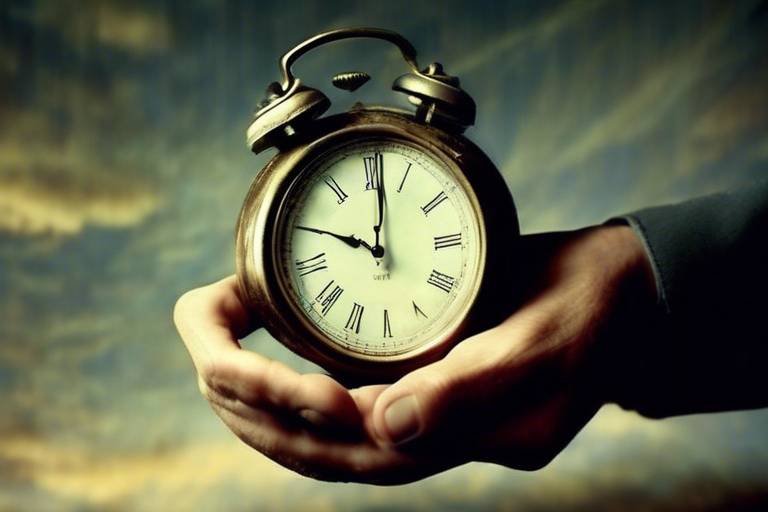
Time is a concept that has perplexed philosophers, scientists, and thinkers throughout history. It’s not just a measure of seconds, minutes, or hours; it’s a fundamental aspect of our existence that shapes how we perceive reality. In the realm of metaphysics, time takes on a much deeper significance. It raises questions about the nature of reality, existence, and our human experience. How do we understand time? Is it a linear progression, or does it cycle back on itself? These questions are not just academic; they touch on the very essence of what it means to be human.
As we embark on this exploration of time within metaphysical frameworks, we will uncover various theories and perspectives that have emerged over centuries. From the ancient Greeks, who laid the groundwork for our understanding of time, to contemporary thinkers who challenge our preconceived notions, the journey through time is as complex as the concept itself. We will delve into the historical perspectives on time, examining how different philosophers have defined and interpreted it. This will set the stage for a deeper inquiry into how time influences our understanding of existence and reality.
Moreover, we will discuss the contrasting views of time as linear versus cyclical. This distinction is not merely academic; it has profound implications for how we perceive our lives and the universe. Imagine time as a river, flowing in one direction—this is the linear view. Now, consider a wheel that turns endlessly, representing the cyclical perspective. Each view offers unique insights into the nature of reality and our place within it.
As we navigate through these ideas, we will also touch on the subjective experience of time. Have you ever noticed how time seems to fly when you’re having fun but drags on during a boring meeting? This perception of time is crucial in understanding its metaphysical significance. Our experiences shape how we interpret the passage of time, influencing everything from our memories to our expectations for the future.
In addition to these philosophical explorations, we will investigate the relationship between time and causality. How does the order of events shape our understanding of reality? This inquiry will lead us to ponder the implications of time travel—a fascinating concept that challenges our traditional views on identity and causation. Can we change the past? What does that mean for our understanding of time itself?
Finally, we will explore the intersection of time and quantum physics, where scientific theories often blur the lines of metaphysical thought. The way time is treated in quantum mechanics can radically alter our understanding of reality, pushing the boundaries of what we know and believe.
As we conclude our exploration, we will reflect on the metaphysical implications of the future, present, and past. Each dimension of time offers unique insights into our existence and serves as a reminder that time is not just a measurement but a profound aspect of our reality. Join us as we delve into this intricate tapestry of time, existence, and what it means to be human.
- What is the significance of time in metaphysics? Time is fundamental in metaphysics as it shapes our understanding of existence, reality, and human experience.
- How do different philosophers view time? Philosophers have varying interpretations of time, ranging from linear to cyclical views, each with unique implications for reality.
- What is the relationship between time and causality? The sequence of events in time influences our understanding of cause and effect, which is crucial in metaphysical theories.
- Can time travel exist? Time travel raises complex questions about identity and causation, challenging our traditional views of time.
- How does quantum physics relate to time? Quantum physics offers new insights into the nature of time, often challenging our conventional understanding of reality.
Historical Perspectives on Time
The concept of time has captivated the minds of philosophers for centuries, serving as a fundamental element in understanding existence and reality. From the ancient musings of Aristotle to the complex theories of modern thinkers, the interpretation of time has undergone significant transformations. Aristotle, for instance, viewed time as a measure of change, suggesting that without change, there could be no time. He famously stated that time is “the number of motion according to the before and after.” This perspective laid the groundwork for future discussions about the nature of time, emphasizing its relationship with motion and change.
As we move through history, we encounter St. Augustine, who introduced a more introspective approach to time. He posed a fascinating question: “What then is time? If no one asks me, I know what it is. If I wish to explain it to him who asks, I do not know.” Augustine’s reflections highlight the subjective experience of time, suggesting that it is not merely a linear progression but an intricate tapestry woven from our perceptions and experiences. This notion marked a significant shift from the objective measurements of time to a more personal understanding of its flow.
Fast forward to the 17th century, and we meet Isaac Newton, who revolutionized the scientific view of time. Newton’s concept of absolute time suggested that time exists independently of events and is uniform throughout the universe. This idea aligned with his laws of motion, where time serves as a constant backdrop against which all events occur. However, this view was later challenged by Immanuel Kant, who argued that time is not an entity that exists outside of human perception but rather a framework through which we understand our experiences. Kant’s perspective emphasizes that time is a necessary condition for human experience, shaping our understanding of reality.
In the 20th century, the advent of Einstein’s theory of relativity further complicated our understanding of time. Einstein proposed that time is not a constant; rather, it is relative and can be affected by speed and gravity. This revolutionary idea shattered the classical notion of time as a linear, unchanging entity and introduced the concept of spacetime, where time and space are interwoven. The implications of this theory extend beyond physics, prompting philosophical inquiries into the nature of reality and existence. As we delve deeper into the 20th century, we find philosophers like Martin Heidegger, who explored time’s existential dimensions, linking it to human freedom and our quest for meaning.
To summarize the evolution of thought regarding time, we can observe the following key perspectives:
| Philosopher | Perspective on Time |
|---|---|
| Aristotle | Time as a measure of change |
| St. Augustine | Subjective experience of time |
| Isaac Newton | Absolute time as a constant |
| Immanuel Kant | Time as a framework for understanding experience |
| Albert Einstein | Time as relative and intertwined with space |
| Martin Heidegger | Existential dimensions of time |
As we can see, the historical perspectives on time reflect a rich tapestry of thought, revealing how our understanding of this elusive concept has evolved over time. Each philosopher contributed unique insights, shaping our current metaphysical inquiries into the nature of time and its implications for existence and reality.
- What is the philosophical significance of time? Time is crucial in metaphysics as it shapes our understanding of existence, reality, and human experience.
- How did ancient philosophers view time? Ancient philosophers like Aristotle viewed time as a measure of change, emphasizing its relationship with motion.
- What is the difference between linear and cyclical time? Linear time views time as a straight progression, while cyclical time sees it as repeating cycles.
- How does modern physics influence our understanding of time? Theories like Einstein’s relativity challenge traditional views, suggesting that time is relative and affected by speed and gravity.
Time as a Linear vs. Cyclical Concept
When we think about time, it often feels like a straightforward path stretching from the past to the future. This is the linear concept of time, where moments are like beads on a string—each one distinct, never to be revisited. Imagine walking down a long, straight road; you can only move forward, and every step takes you further away from where you started. This perspective has been dominant in Western thought, largely influenced by thinkers such as Isaac Newton and later philosophers like Immanuel Kant, who viewed time as a measurable, objective phenomenon that governs our universe.
On the flip side, we have the cyclical concept of time, which presents a more holistic view. Here, time is not a straight line but rather a repeating cycle, akin to the seasons changing or the phases of the moon. This perspective is deeply rooted in many ancient cultures and philosophies, from the Hindu concept of Kalachakra (the wheel of time) to the Chinese idea of Yin and Yang. Picture a circle: no beginning, no end, just a continuous loop where events recur, and history has a tendency to repeat itself. This cyclical view can be comforting, suggesting that life is a series of opportunities rather than a one-way street.
So, why does this distinction matter? Well, each perspective has profound implications on how we understand our existence and reality. For example, in a linear framework, we might feel a sense of urgency to achieve our goals before time runs out, leading to a more goal-oriented mindset. In contrast, a cyclical understanding can foster a sense of patience and acceptance, as it implies that every ending is just a new beginning. This can influence everything from our personal relationships to how we approach our careers.
To further illustrate these concepts, consider the following table that highlights key differences:
| Aspect | Linear Time | Cyclical Time |
|---|---|---|
| Nature | One-directional | Repetitive |
| Philosophical Roots | Western Philosophy | Eastern Philosophy |
| Perception of Life | Finite, Goal-oriented | Infinite, Opportunity-focused |
| Impact on Behavior | Urgency, Achievement | Patience, Acceptance |
Ultimately, the way we perceive time can shape our actions and thoughts in profound ways. Are we racing against the clock, or do we see ourselves as part of a larger cycle? This question invites us to explore our own beliefs about time and how they affect our lives. So, the next time you glance at a clock or reflect on your past, consider: are you on a linear path, or are you dancing in a cyclical rhythm? The answer might just change how you approach your day-to-day existence.
The Nature of Temporal Experience
The experience of time is a fascinating aspect of human existence, one that we often take for granted. Have you ever stopped to think about how time feels? It can seem to fly by during moments of joy or crawl during times of boredom. This subjective experience of time is a rich area of inquiry in metaphysics, as it challenges our understanding of reality and existence. When we delve into the nature of temporal experience, we uncover layers of complexity that reveal not just how we perceive time, but also how it shapes our lives.
To grasp this concept, we must first acknowledge that our perception of time is not a straightforward measure of seconds, minutes, or hours. Instead, it is a deeply personal and often emotional experience. For instance, consider how a child’s birthday party feels compared to waiting in line at the DMV. The former is filled with excitement, laughter, and joy, making time seem to pass in the blink of an eye. In contrast, the latter often feels like an eternity. This dichotomy illustrates how time is not merely a sequence of events but is intertwined with our emotional states and cognitive processes.
Moreover, our temporal experience is influenced by various factors, including:
- Memory: Our recollection of past events can distort our perception of time. Memories can feel vivid and immediate, making the past seem closer than it actually is.
- Anticipation: The excitement of future events can make the present feel prolonged as we eagerly await what is to come.
- Attention: The more we focus on a moment, the longer it seems to last. This is why time appears to stretch during moments of intense concentration.
This interplay between memory, anticipation, and attention leads us to question whether time is an objective reality or a subjective experience. Are we merely observers of time, or are we active participants in shaping our temporal realities? Some philosophers argue that time is an illusion, a construct of human consciousness that allows us to navigate the complexities of existence. Others maintain that time exists independently of our perception, serving as a backdrop against which life unfolds.
Furthermore, the nature of temporal experience raises intriguing questions about identity. If our perception of time can change based on our emotional and cognitive states, does that mean our sense of self is also fluid? Just as time can feel elastic, so too can our identities shift and evolve. This fluidity challenges the concept of a fixed self, suggesting that we are in a constant state of becoming, influenced by our experiences across time.
In addition, the philosophical implications of temporal experience extend to our understanding of reality itself. If time is subjective, how does that affect our grasp of causality and existence? The sequence of events in our lives, shaped by our unique experiences of time, influences how we interpret reality. This subjective lens can lead to vastly different understandings of the same event, highlighting the complexity of human experience.
As we navigate these questions, it becomes clear that the nature of temporal experience is not just an academic inquiry but a deeply personal exploration. Each individual’s relationship with time is unique, colored by their emotions, memories, and anticipations. In this way, time becomes a canvas upon which we paint our experiences, shaping not only how we perceive the world but also how we understand ourselves within it.
- What is temporal experience? Temporal experience refers to how individuals perceive and feel time, which can vary significantly based on emotional and cognitive states.
- How does memory affect our perception of time? Memory can distort our perception of time, making past events feel closer or more vivid than they actually are.
- Is time objective or subjective? This is a philosophical debate; some argue that time is an illusion shaped by human consciousness, while others believe it exists independently of our perception.
- How does anticipation influence our experience of time? Anticipation can stretch our experience of the present as we eagerly await future events, altering our perception of time’s passage.
Time and Causality in Metaphysics
When we delve into the intricate relationship between time and causality in metaphysics, we uncover a fascinating tapestry that weaves together our understanding of existence and reality. At its core, causality refers to the principle that every effect has a cause, a notion that seems straightforward at first glance. However, when we introduce the dimension of time into this equation, things get a bit murky. How do we define the sequence of events? Does time flow in a straight line, or is it more like a tangled ball of yarn?
To illustrate this, let’s consider a simple example: imagine you drop a glass of water. The glass falls, hits the ground, and shatters. Here, the act of dropping the glass is the cause, and the shattering is the effect. But what if we take a step back and ask, “What caused you to drop the glass in the first place?” This leads us down a rabbit hole of causation that can stretch back through time, raising questions about free will, determinism, and the very nature of reality.
In metaphysical discussions, time is often seen as a linear progression, where past events lead to present occurrences, which in turn shape future outcomes. This perspective aligns with our everyday experiences and is the foundation of much scientific inquiry. However, some philosophers argue for a more cyclical understanding of time, suggesting that events are part of a repeating cycle, which complicates our grasp of causality. This cyclical view raises profound questions: if events are destined to repeat, what does that mean for our understanding of free will? Are we merely acting out roles in a cosmic play, with our actions predetermined?
Moreover, the implications of causality extend beyond mere events. They touch on the very fabric of reality itself. Consider the following key points regarding time and causality:
- Temporal Order: The order of events matters. If causality is to hold true, then the cause must precede the effect in time.
- Simultaneity: What happens when events occur simultaneously? Does it challenge our understanding of causation?
- Time as a Dimension: In modern physics, time is treated as a dimension similar to space, leading to intriguing questions about how we perceive causality.
The relationship between time and causality also has profound implications in various fields, including philosophy, physics, and even psychology. For instance, in quantum physics, the notion of causality is challenged by phenomena such as entanglement, where particles seem to influence each other instantaneously across vast distances, defying our traditional understanding of time. This intersection of time and causality invites us to rethink our metaphysical frameworks and consider alternative models of reality.
In the realm of metaphysics, the exploration of time and causality does not yield easy answers. Instead, it opens up a Pandora’s box of questions that challenge our perceptions and beliefs. Are we bound by the linearity of time, or can we transcend it? How does our understanding of causality shape our actions and decisions? These inquiries not only enrich our philosophical discourse but also enhance our comprehension of what it means to exist in a temporal reality.
- What is the relationship between time and causality? Time provides the framework within which causality operates, establishing the sequence of events and their interconnections.
- Can causality exist without time? Most philosophical perspectives argue that causality is inherently tied to time, as causes must precede their effects.
- How does quantum physics affect our understanding of time and causality? Quantum phenomena challenge traditional notions of causality, suggesting that events can be interconnected in ways that defy our conventional understanding of time.
- What are the philosophical implications of cyclical time? Cyclical views of time raise questions about free will and determinism, suggesting that events may repeat indefinitely, affecting our understanding of choice and consequence.
Philosophical Implications of Time Travel
Time travel has long fascinated both scientists and philosophers alike, igniting imaginations and sparking deep philosophical debates. Imagine being able to leap through time, visiting the past or future at will! But what does this mean for our understanding of time, identity, and causality? The implications of time travel challenge the very fabric of our metaphysical frameworks. When we think about time travel, we must consider questions like: If we can change events in the past, do we alter our present reality? And if we can visit the future, does that mean our future is predetermined or still malleable?
One of the most intriguing philosophical dilemmas posed by time travel is the concept of the “grandfather paradox.” This paradox arises when a time traveler goes back in time and inadvertently prevents their grandfather from meeting their grandmother. If that happens, the time traveler would never be born, leading to a logical contradiction. This paradox highlights the complexities of causality and raises questions about the nature of time itself. Is time a fixed sequence of events, or is it more fluid, allowing for multiple timelines?
Furthermore, the implications extend beyond mere causal relationships. Time travel invites us to reflect on our identity. If a person travels to the past and interacts with their younger self, who are they in that moment? Are they the same person, or do they exist in two different states of being? This notion leads us to ponder the essence of self and continuity over time. Are we merely a collection of experiences, or is there a deeper, unchanging core that defines us?
Another fascinating aspect to consider is the ethical dimension of time travel. If one had the ability to travel back in time to prevent tragedies or alter significant events, should they do so? The moral implications of such actions can be staggering. Would the benefits of saving lives outweigh the potential consequences of changing history? Philosophers like David Lewis argue that every time a time traveler makes a change, they create a new timeline, thus preserving the original timeline’s integrity. This perspective opens up a multitude of possibilities, suggesting that our choices in time travel could lead to entirely different realities coexisting alongside our own.
Moreover, time travel challenges our understanding of determinism. If the future is already set, what does it mean to travel to it? Can we change our fates, or are we merely spectators of a predestined path? This question blurs the lines between free will and determinism, forcing us to confront our beliefs about agency and responsibility in a world where time is not linear but rather a complex tapestry of possibilities.
In conclusion, the philosophical implications of time travel stretch far beyond the realm of science fiction. They invite us to explore profound questions about existence, identity, causality, and morality. As we contemplate the potential of time travel, we find ourselves grappling with the very nature of reality and our place within it. Ultimately, time travel serves as a mirror reflecting our deepest philosophical inquiries, challenging us to reconsider what we know about time and existence.
- Can time travel really exist? While time travel remains a theoretical concept, scientific theories like relativity suggest it could be possible under certain conditions.
- What is the grandfather paradox? The grandfather paradox is a hypothetical scenario where a time traveler prevents their own existence by altering past events.
- How does time travel affect our understanding of identity? Time travel raises questions about whether we remain the same person across different timelines or if our identity is fluid.
- Are there ethical implications to time travel? Yes, time travel poses significant ethical dilemmas, especially regarding altering historical events and their consequences.
Time in Quantum Physics
The intersection of time and quantum physics is a fascinating realm that challenges our conventional understanding of reality. In classical physics, time is often viewed as a constant, a linear progression from past to future. However, when we dive into the quantum world, things start to get a bit murky. Imagine walking into a room where the walls are made of glass, and every time you look away, the room shifts and changes. This is somewhat akin to how time behaves in quantum physics—it’s not as straightforward as it seems.
One of the most mind-bending concepts in quantum physics is the idea of superposition. In this state, particles can exist in multiple states at once until they are observed. This raises profound questions about the nature of time. If a particle can be in multiple states simultaneously, does that mean it exists in multiple times? Are we merely perceiving a single timeline among many potential realities? These questions force us to reconsider our understanding of temporal progression.
Moreover, the concept of entanglement adds another layer to the discussion. When two particles become entangled, the state of one instantly influences the state of the other, regardless of the distance separating them. This phenomenon seems to imply a non-linear relationship with time. If information can be transmitted instantaneously, does that mean time is not the absolute barrier we once thought? It’s as if time is more of a tapestry, with threads interwoven in ways we are just beginning to understand.
To illustrate these concepts further, let’s look at a comparison of classical and quantum perspectives on time:
| Aspect | Classical Physics | Quantum Physics |
|---|---|---|
| Nature of Time | Linear and absolute | Non-linear and relative |
| State of Particles | Defined until measured | Superposition until observed |
| Influence of Observation | None | Critical in determining state |
| Causality | Clear cause and effect | Potentially ambiguous |
As we further explore these ideas, we encounter the concept of time dilation, which is a core principle in both quantum mechanics and relativity. Time dilation suggests that time can pass at different rates depending on speed and gravity. Imagine two twins: one stays on Earth while the other travels through space at near-light speed. When they reunite, the traveling twin is younger than the one who stayed behind. This phenomenon not only challenges our perception of time but also raises questions about the very fabric of reality itself.
In summary, the relationship between time and quantum physics is anything but straightforward. It invites us to rethink our assumptions and opens up a world of possibilities. As scientists continue to unravel the mysteries of quantum mechanics, we may find that time is not just a measure of change, but a complex dimension that shapes our understanding of existence itself.
- What is superposition in quantum physics? Superposition refers to a fundamental principle where a quantum system can exist in multiple states at the same time until it is measured.
- How does entanglement affect our understanding of time? Entanglement suggests that particles can instantaneously affect each other regardless of distance, challenging the traditional linear view of time.
- What is time dilation? Time dilation is the phenomenon where time passes at different rates depending on the relative speed and gravitational field, as demonstrated in the twin paradox scenario.
The Role of Time in Existential Philosophy
Time, in the realm of existential philosophy, is not merely a sequence of moments ticking away on a clock; it is the very fabric that weaves together our experiences, choices, and the essence of our being. Existentialists like Jean-Paul Sartre and Martin Heidegger have profoundly shaped our understanding of how time influences human existence. For them, time is deeply intertwined with our sense of freedom and the search for meaning in an often chaotic world.
Heidegger, in particular, introduced the concept of “Being-toward-death,” which emphasizes the importance of our awareness of mortality in shaping our temporal experience. This awareness compels us to confront the finite nature of our existence, urging us to live authentically. He argues that by acknowledging our impending death, we can truly appreciate the “now” and make choices that reflect our genuine selves, rather than succumbing to societal expectations.
In contrast, Sartre posits that time is a canvas for human freedom. He famously stated, “We are condemned to be free,” suggesting that our choices define us and that we must navigate the future with the weight of our past decisions. The existential experience of time is thus fraught with tension; we are constantly caught between what has been and what could be. This dichotomy can lead to feelings of anxiety, as we grapple with the implications of our choices and the inevitability of time’s passage.
Moreover, existential philosophy often highlights the subjective nature of time. Unlike the objective measurement of seconds and minutes, our perception of time can stretch and contract based on our experiences. For instance, moments of joy may feel fleeting, while periods of suffering can seem to drag on endlessly. This fluidity of time is pivotal in existential thought, as it underscores the idea that our lived experiences shape our understanding of reality.
To further illustrate the philosophical implications of time in existentialism, consider the following table that contrasts key existential thinkers and their views on time:
| Philosopher | View on Time | Key Concepts |
|---|---|---|
| Martin Heidegger | Being-toward-death | Authenticity, Finitude |
| Jean-Paul Sartre | Freedom and Choice | Condemnation to be Free, Anxiety |
| Simone de Beauvoir | Temporal Existence | Ethics of Freedom, Responsibility |
Existentialists also grapple with the implications of past, present, and future. The past informs our identity, the present is where we exercise our freedom, and the future represents possibilities yet to be realized. This triadic relationship is crucial for understanding how we navigate our lives. It’s a delicate dance, where each step can lead us closer to or further from our authentic selves.
In conclusion, the role of time in existential philosophy is multifaceted and deeply significant. It challenges us to confront our mortality, embrace our freedom, and recognize the subjective nature of our experiences. By doing so, we can cultivate a richer understanding of our existence and the choices that define us. As we ponder our place in the universe, time becomes not just a measure of existence but a profound teacher, guiding us towards a more authentic life.
- How do existential philosophers view the concept of time? Existential philosophers see time as integral to human experience, shaping our identity, choices, and the quest for meaning.
- What is the significance of “Being-toward-death” in existential thought? This concept emphasizes the importance of recognizing our mortality, which can lead to a more authentic and meaningful life.
- How does subjective experience of time differ from objective time? Subjective time varies based on individual experiences, where moments of joy may feel short-lived and moments of suffering may seem prolonged.
Future, Present, and Past: A Metaphysical Inquiry
When we think about time, we often find ourselves caught in the web of the future, present, and past. Each of these dimensions offers a different lens through which we can examine our existence and the nature of reality. Have you ever wondered how the past shapes who you are today? Or how the uncertainty of the future influences your decisions? This inquiry into the metaphysical implications of these time dimensions can lead us to profound insights about life itself.
The past is like a tapestry woven with our experiences, memories, and lessons learned. It serves not only as a record of what has transpired but also as a foundation upon which we build our present. Philosophers like Henri Bergson argued that the past is not merely a sequence of events but a living part of our consciousness. We carry our past with us, shaping our identities and influencing our choices. In this sense, the past is not just gone; it continuously informs our reality.
On the other hand, the present is where we actually live. It is the fleeting moment that slips through our fingers like sand. This is where our actions take place, where we experience life in its rawest form. The existentialists, such as Jean-Paul Sartre, emphasized the importance of the present moment, arguing that it is the only time we truly possess. In this light, the present becomes a canvas for our freedom and choices, a space where we can create meaning amidst the chaos of existence.
Then, we have the future, that tantalizing realm filled with possibilities and uncertainties. It is often the source of our hopes and fears. The future beckons us with dreams, yet it remains elusive, a blank slate waiting to be filled. The concept of the future raises intriguing metaphysical questions: Is it predetermined, or do we have the power to shape it through our actions? Philosophers like Gilles Deleuze have suggested that the future is not merely a continuation of the past, but rather a space of potentiality, where new realities can emerge.
To encapsulate these ideas, consider the following table that illustrates how each dimension of time interacts with our understanding of existence:
| Dimension of Time | Philosophical Implications | Influence on Human Experience |
|---|---|---|
| Past | Foundation of identity and memory | Shapes our present actions and decisions |
| Present | Site of freedom and choice | Where life is experienced and meaning is created |
| Future | Realm of potentiality and uncertainty | Source of hopes, aspirations, and fears |
Ultimately, the interplay between the past, present, and future is not just a theoretical exercise; it profoundly affects how we perceive our lives and our place in the universe. Each dimension serves as a mirror reflecting our existential struggles and triumphs. As we navigate through these temporal realms, we find ourselves asking: How do we reconcile our past with our present desires? How do we prepare for a future that remains uncertain? These questions compel us to engage with our existence more deeply, prompting a quest for meaning that transcends time itself.
- What is the significance of the past in our lives?
The past shapes our identities and influences our present choices, serving as a foundation for who we are. - Why is the present considered the most important dimension of time?
The present is where we experience life and make choices, highlighting our freedom and ability to create meaning. - How does the future affect our decisions?
The future represents potential and uncertainty, often guiding our hopes and fears, influencing our actions in the present.
Frequently Asked Questions
- What is the metaphysical concept of time?
Metaphysical time refers to the philosophical exploration of the nature, existence, and implications of time beyond mere measurement. It delves into how time influences reality, existence, and our human experience, prompting profound questions about what it means to exist in time.
- How have historical perspectives shaped our understanding of time?
Throughout history, philosophers like Aristotle and Kant have offered varying interpretations of time. Aristotle viewed time as a measure of change, while Kant proposed that time is a framework through which we perceive events. These historical insights have evolved and contributed to contemporary metaphysical theories.
- Is time linear or cyclical?
This is a hotly debated topic! Some cultures and philosophies view time as cyclical, suggesting a repeating pattern of events, while others see it as linear, moving from past to future. Each perspective offers unique implications for our understanding of existence and reality.
- How does human perception influence our experience of time?
Our subjective experience of time can vary widely depending on emotions, activities, and context. For instance, time may seem to fly during enjoyable moments but drag during tedious ones. This perception plays a crucial role in how we understand the flow of time and its metaphysical significance.
- What is the relationship between time and causality?
In metaphysics, time and causality are intertwined; the sequence of events shapes our understanding of reality. Causality implies that every effect has a cause, which occurs within a temporal framework, raising questions about the nature of time itself and how it governs events.
- What are the philosophical implications of time travel?
Time travel poses intriguing challenges to our understanding of identity, causation, and the nature of time. It raises questions about whether past events can be altered and how such changes would affect our present and future realities, creating a fascinating discourse in metaphysics.
- How does quantum physics intersect with metaphysical views of time?
Quantum physics introduces complex ideas about time, such as the possibility of non-linear time and the role of observation in determining reality. These scientific theories can reshape metaphysical perspectives, leading to discussions about the nature of existence and the fabric of reality itself.
- What role does time play in existential philosophy?
Existential philosophers emphasize the significance of time in shaping human existence and freedom. They argue that our awareness of time influences our search for meaning and how we confront our mortality, making it a central theme in existential thought.
- How do the concepts of past, present, and future relate to metaphysics?
The past, present, and future are fundamental to metaphysical inquiries. Each dimension of time shapes our understanding of reality and existence, prompting questions about memory, anticipation, and the nature of change, which are essential to our human experience.
Temporal Ontology, Time Perception, Presentism, Eternalism, A-Series and B-Series, Causality, Time Dilation, Flow of Time, , Temporal Ontology, Time Perception, Presentism, Eternalism, A-Series and B-Series, Causality, Time Dilation, Flow of Time,
Share this content:
Leave a Reply