
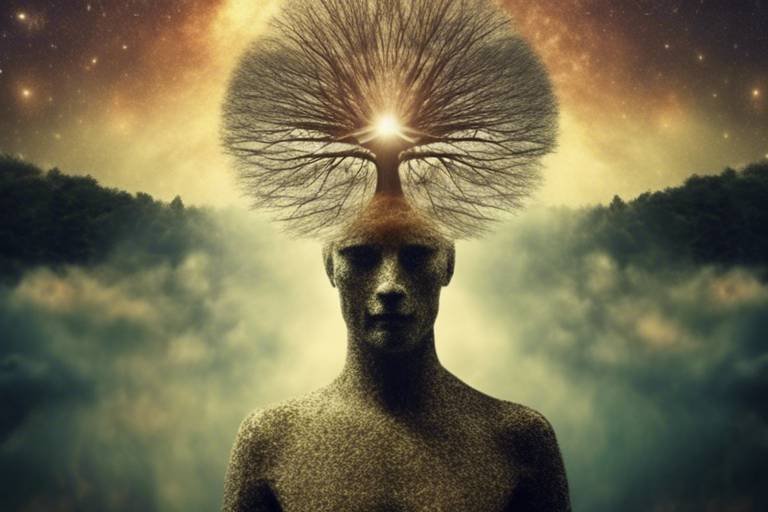
Metaphysics, a profound and often perplexing branch of philosophy, invites us to embark on a journey that transcends the surface of everyday existence. At its core, it seeks to unravel the intricate tapestry of reality, probing questions that many of us ponder but rarely articulate. What does it mean to exist? Is there a reality beyond our perception? How do our thoughts shape the universe around us? These questions not only spark curiosity but also challenge our understanding of life and the cosmos.
Imagine standing at the edge of a vast ocean, the waves crashing against the shore, each ripple a reminder of the complexities of existence. Just like the ocean, reality is deep and multifaceted, filled with mysteries waiting to be explored. Metaphysics serves as our philosophical vessel, guiding us through the waters of existence, urging us to dive deeper into the nature of being, time, space, and causality.
One of the most intriguing aspects of metaphysics is its ability to bridge the gap between abstract concepts and tangible experiences. It encourages us to question not only the world around us but also our place within it. Are we mere observers, or do we actively shape the reality we inhabit? This inquiry leads to a rich dialogue between perception and existence, where our understanding of reality is continually evolving.
Furthermore, metaphysics doesn’t operate in a vacuum; it intertwines with other fields, such as science, psychology, and art, creating a holistic view of existence. The interplay between these disciplines enriches our understanding, revealing that the questions we ask about reality are as much about the universe as they are about ourselves. In this sense, metaphysics is not just a philosophical pursuit; it is a way of understanding our very essence and the universe we inhabit.
As we delve deeper into the nature of reality through the lens of metaphysics, we uncover layers of meaning that challenge our perceptions and beliefs. This exploration is not merely academic; it is a personal journey that invites each of us to reflect on our existence and the reality we create. So, what does metaphysics ultimately reveal about the nature of reality? It shows us that reality is not a fixed entity but a dynamic interplay of existence, perception, and thought, urging us to embrace the complexity of life and the universe.
- What is the main focus of metaphysics? Metaphysics primarily explores the fundamental nature of reality, including concepts such as being, existence, and the universe.
- How does metaphysics differ from other branches of philosophy? While other branches may focus on ethics, logic, or aesthetics, metaphysics specifically addresses questions about existence and the nature of reality.
- Can metaphysical concepts be tested scientifically? Some aspects of metaphysics can be examined through scientific inquiry, but many metaphysical questions remain philosophical in nature.
- Why is metaphysics important? It encourages deep contemplation about our existence and helps shape our understanding of life, reality, and the cosmos.
The Definition of Metaphysics
Metaphysics is a fascinating branch of philosophy that dives deep into the fundamental nature of reality. It’s like peeling back the layers of an onion—each layer revealing more about existence, being, and the universe around us. At its core, metaphysics seeks to answer some of the most profound questions that humanity has ever pondered. What does it mean to exist? What is the nature of objects? How do we define reality? These inquiries are not just academic; they touch upon our daily lives and shape our understanding of the world.
To truly grasp the implications of metaphysics, it’s essential to break down its primary components. Metaphysics can be divided into several key areas, including ontology, which studies the nature of being, and cosmology, which explores the origins and structure of the universe. These components work together to provide a framework for understanding the complexities of existence.
Moreover, metaphysics challenges us to consider our perceptions. How do we know what we know? Our sensory experiences play a critical role in how we interpret reality. For instance, when we perceive a tree, is that tree merely an object in our field of vision, or does it hold a deeper significance that transcends our immediate experience? This question leads us into the realm of epistemology, which examines the nature and scope of knowledge.
In essence, metaphysics is not just an abstract field of study; it has real implications for our lives. It influences our beliefs, our understanding of science, and even our spiritual perspectives. By exploring metaphysical questions, we engage in a journey that can reshape our worldview and deepen our appreciation for the universe.
In summary, metaphysics invites us to look beyond the surface of reality and consider the underlying principles that govern existence. It encourages a sense of wonder and curiosity, pushing us to ask questions that, while difficult, are essential for a comprehensive understanding of life and the cosmos.
Key Philosophical Questions
Metaphysics is a vast ocean of inquiry, and it poses some of the most profound questions that have intrigued humanity for centuries. At the heart of metaphysical exploration lies a series of essential inquiries that challenge our understanding of existence, reality, and the universe itself. These questions are not just academic; they resonate deeply with our everyday experiences and perceptions. For instance, we often find ourselves pondering: What does it mean to exist? Is our reality merely a construct of our minds, or does it exist independently of us? Such questions invite us to dive deeper into the essence of being and challenge our assumptions about the world around us.
One of the most fundamental questions in metaphysics is the distinction between existence and non-existence. This inquiry compels us to consider the criteria for something to be deemed ‘real.’ Is it enough for something to be perceived, or must it have an objective existence outside of our consciousness? This leads us to another crucial question: How do we define reality itself? This definition can vary dramatically depending on philosophical perspectives, from the concrete to the abstract. It’s like trying to catch smoke with your bare hands; the more you grasp, the more elusive it becomes.
Furthermore, metaphysics challenges us to examine the nature of objects and their properties. Are objects merely collections of atoms, or do they possess intrinsic qualities that define their essence? This inquiry pushes us to explore the relationship between objects and our perception of them. Are we simply observers in a grand theater, or do we play an active role in shaping reality? The answers to these questions can significantly alter our worldview.
Another key area of metaphysical inquiry concerns the nature of causality. What does it mean for one event to cause another? This question leads us into the realms of determinism and free will, where the implications of causation become even more complex. Are our actions predetermined by prior events, or do we possess the freedom to choose our paths? The interplay between these concepts not only affects philosophical discourse but also influences our daily lives and decisions.
To illustrate the complexity of these philosophical questions, consider the following table that summarizes some of the key inquiries in metaphysics:
| Key Inquiry | Description |
|---|---|
| Existence vs. Non-existence | What criteria define reality and existence? |
| Nature of Objects | Do objects have intrinsic qualities, or are they mere aggregates? |
| Causality | What is the relationship between cause and effect? |
| Determinism vs. Free Will | Are our actions predetermined, or do we have the freedom to choose? |
In conclusion, the key philosophical questions posed by metaphysics serve as a guiding light in our quest to understand the nature of reality. They invite us to challenge our perceptions, explore our beliefs, and ultimately seek a deeper comprehension of existence itself. As we navigate through these inquiries, we not only enrich our philosophical understanding but also enhance our appreciation for the complexities of life and the universe.
- What is metaphysics? Metaphysics is a branch of philosophy that studies the fundamental nature of reality, including concepts like being, existence, and the universe.
- Why are metaphysical questions important? They help us understand the nature of existence and challenge our assumptions about reality.
- How does metaphysics relate to science? Metaphysics and science both seek to understand reality, but they approach it from different angles, often informing each other.
Existence vs. Non-existence
The distinction between existence and non-existence is not just a philosophical debate; it is a profound inquiry that challenges our understanding of reality itself. Imagine standing at the edge of a vast ocean, where the waves represent everything that exists, and the stillness beyond symbolizes what does not. This metaphor encapsulates the essence of metaphysical discussions surrounding existence. What does it truly mean for something to ‘be’? Is existence merely a state of being, or is it something much deeper? These questions have puzzled thinkers for centuries.
To grasp this distinction, we must first consider the various dimensions of existence. For instance, there are tangible entities like rocks, trees, and animals that we can perceive with our senses. Then, there are abstract concepts such as love, justice, and time, which exist in a different realm. They may not have a physical form, yet they significantly influence our lives and decisions. This leads us to ponder: if something cannot be seen or touched, does it still exist? The metaphysical perspective invites us to explore these nuances and recognize that existence may not be a binary concept but rather a spectrum.
Furthermore, the philosophical implications of existence extend to our understanding of reality. Consider the famous philosophical thought experiment known as Descartes’ Evil Demon. Descartes posited that an evil demon could be deceiving us about everything we perceive, leading us to question the very fabric of our reality. If we cannot trust our senses, how can we assert that anything exists at all? This line of reasoning opens up a Pandora’s box of existential questions that can leave one feeling both enlightened and bewildered.
In metaphysical discourse, the debate often revolves around the following key points:
- Ontology: The study of being and existence, which examines what entities exist and how they can be categorized.
- Epistemology: The investigation of knowledge and belief, questioning how we come to know what exists.
- Existentialism: A philosophical movement that emphasizes individual existence, freedom, and choice, often grappling with the meaning of existence itself.
Ultimately, the distinction between existence and non-existence is not just an academic exercise; it profoundly impacts our daily lives. The way we perceive existence shapes our beliefs, values, and interactions with the world around us. As we navigate this complex landscape, we are encouraged to embrace the uncertainty and mystery that accompany these metaphysical inquiries. After all, the quest for understanding is as significant as the answers we seek.
The Role of Perception
Perception is like the lens through which we view the world; it shapes our understanding of reality in profound ways. Imagine standing in front of a beautiful painting. Each brushstroke, color, and shadow tells a story, but your interpretation of that story is uniquely yours. This subjectivity highlights how our sensory experiences—sight, sound, touch, taste, and smell—play a critical role in shaping our understanding of existence. When we perceive something, we are not merely observing; we are actively engaging with our environment, filtering information through our beliefs, emotions, and past experiences. This interaction raises intriguing questions: Are we truly experiencing reality as it is, or are we merely constructing our own version of it?
Philosophers have long debated the extent to which perception influences our understanding of reality. Some argue that our senses provide an accurate reflection of the world around us, while others contend that perception is inherently flawed and subjective. For instance, consider the phenomenon of optical illusions. They serve as a reminder that what we see can be deceiving, challenging our preconceived notions of reality. In this sense, perception is not just a passive reception of stimuli; it is an active process that can distort or enhance our understanding of the universe.
Moreover, the role of perception extends beyond mere observation. It interplays with our cognitive processes, where our brains interpret sensory data and assign meaning to it. This cognitive aspect can be likened to a chef who combines various ingredients to create a dish. Just as the chef’s choices influence the final flavor, our mental frameworks shape how we perceive and understand the world. This leads to the idea that our perceptions can be influenced by cultural, social, and personal factors, resulting in a diverse tapestry of interpretations of reality.
To illustrate the complexity of perception, consider the following table that summarizes key factors influencing our perceptual experiences:
| Factor | Description |
|---|---|
| Biological | Our sensory organs and neurological pathways determine the basic level of perception. |
| Cultural | Cultural background influences how we interpret sensory information and experiences. |
| Emotional | Emotions can color our perceptions, leading to different interpretations of the same event. |
| Contextual | The environment and situation surrounding an experience can alter our perception of it. |
In conclusion, the role of perception in understanding reality cannot be overstated. It acts as a filter through which we interpret our experiences, shaping our beliefs and understanding of existence. As we navigate through life, it’s essential to recognize that our perceptions are not absolute truths but rather subjective interpretations influenced by various factors. By being aware of this, we can cultivate a more open-minded approach to understanding reality and the diverse perspectives that others may hold.
- What is the difference between perception and reality?
Perception is how we interpret sensory information, while reality is the objective state of things as they exist independently of our perceptions. - Can perception be trusted?
While perception is a valuable tool for navigating the world, it can be influenced by various factors, making it subjective and sometimes unreliable. - How does culture influence perception?
Cultural background shapes our beliefs, values, and experiences, which in turn influence how we interpret sensory information and understand reality.
Philosophical Realism vs. Idealism
When diving into the depths of metaphysics, one cannot ignore the intriguing debate between philosophical realism and idealism. These two schools of thought offer contrasting perspectives on the nature of reality, and understanding their differences can significantly enhance our grasp of existence itself. At its core, realism posits that the external world exists independently of our perceptions. In other words, reality is out there, waiting to be discovered, much like a treasure chest buried beneath the sands of time. Realists argue that objects have properties that remain constant regardless of whether or not we perceive them. For example, a tree standing tall in a forest continues to exist even if no one is around to admire its beauty.
On the flip side, idealism suggests that reality is fundamentally mental, constructed by our perceptions and consciousness. Imagine reality as a canvas, where our thoughts and experiences paint the picture of existence. Idealists contend that what we perceive as the external world is merely a manifestation of our minds. This leads to fascinating questions: If a tree falls in a forest and no one is there to hear it, does it make a sound? For idealists, the answer may lean toward “no,” as sound, like all experiences, relies on a perceiving subject.
The implications of these philosophies stretch far beyond mere academic debate. They influence how we understand our interactions with the world and shape our beliefs about knowledge, truth, and existence. For instance, a realist approach might lead one to seek objective truths through scientific inquiry, while an idealist perspective might emphasize the importance of subjective experiences and interpretations.
To further illustrate the differences between these two philosophies, consider the following table:
| Aspect | Philosophical Realism | Philosophical Idealism |
|---|---|---|
| Nature of Reality | Independent of perception | Dependent on perception |
| Existence of Objects | Objects exist regardless of observation | Objects exist only as perceived |
| Truth | Objective and discoverable | Subjective and constructed |
| Example | A tree exists in the forest | The tree exists only if someone perceives it |
In conclusion, the dialogue between realism and idealism not only enriches our understanding of metaphysics but also invites us to reflect on our personal beliefs about the nature of reality. Are we merely observers in a vast universe, or are we the creators of our own reality? This philosophical inquiry encourages us to explore our perceptions and the impact they have on our understanding of existence.
- What is philosophical realism? – It is the belief that reality exists independently of our perceptions.
- What is philosophical idealism? – It is the belief that reality is mentally constructed and dependent on our perceptions.
- How do realism and idealism affect our understanding of truth? – Realism views truth as objective, while idealism sees it as subjective.
- Can both philosophies coexist? – Yes, many people find value in elements of both realism and idealism in their worldview.
Time and Space in Metaphysics
When we dive into the depths of metaphysics, one of the most mind-bending aspects we encounter is the nature of time and space. These two concepts are not merely background elements of our existence; they are fundamental components that shape our understanding of reality itself. Imagine time as a river flowing endlessly, carrying with it every moment of existence, while space acts as the vast ocean in which this river navigates. This analogy helps us grasp the intricate relationship between time and space, yet it only scratches the surface of the metaphysical inquiry surrounding them.
Philosophers have long debated whether time and space are absolute entities that exist independently of the objects within them or if they are merely constructs of human perception. Isaac Newton famously posited that time and space are immutable frameworks that exist regardless of the events that occur. In contrast, Immanuel Kant argued that they are not inherent features of the universe but rather the lenses through which we perceive reality. This philosophical tug-of-war raises profound questions: Is time a linear progression from past to future, or is it cyclical? Does space exist without objects to occupy it?
To illustrate these philosophical positions, we can consider a simple table that summarizes the contrasting views on time and space:
| Philosopher | View on Time | View on Space |
|---|---|---|
| Isaac Newton | Absolute and linear | Absolute and independent |
| Immanuel Kant | Subjective and perceptual | Subjective and relational |
Moreover, the implications of time and space extend beyond mere philosophical discourse. In the realm of modern physics, particularly with the advent of Einstein’s theory of relativity, we see a revolutionary shift in how these concepts are understood. Einstein proposed that time and space are intertwined in a single continuum known as spacetime. This idea suggests that the fabric of the universe is flexible, capable of bending and warping in response to mass and energy. It’s like imagining a trampoline where the heavier you are, the more you create a dent, affecting the movement of anything nearby. This understanding not only challenges our traditional views but also opens up new avenues for exploring the universe.
As we ponder the nature of time and space in metaphysics, we also encounter the question of eternity. What does it mean for something to exist outside of time? Can we even fathom a reality where time does not flow? These questions can leave us feeling dizzy, as if we are trying to grasp smoke with our bare hands. Yet, they are essential for understanding our place in the cosmos. Are we merely fleeting moments in a vast expanse, or is there a deeper connection that transcends our temporal existence?
In conclusion, the exploration of time and space in metaphysics is a journey that challenges our perceptions and invites us to question the very fabric of reality. Whether viewed as absolute entities or subjective constructs, their significance in shaping our understanding of existence cannot be understated. As we continue to unravel these mysteries, we might just find that the universe has more surprises in store for us than we ever imagined.
- What is metaphysics? Metaphysics is a branch of philosophy that studies the fundamental nature of reality, including concepts such as existence, being, and the universe.
- How do time and space relate to metaphysics? Time and space are foundational concepts in metaphysics, prompting questions about their nature, existence, and how they influence our understanding of reality.
- What is the difference between determinism and free will? Determinism suggests that all events are determined by preceding events, while free will posits that individuals can make choices independent of external influences.
The Nature of Causality
Causality is a fascinating concept that lies at the heart of metaphysical inquiry. It examines how events are interconnected, revealing the intricate web of relationships that define our reality. When we ponder causality, we are essentially asking, “What makes things happen?” This question is not just a philosophical musing; it has profound implications for how we understand the universe and our place within it. To grasp the nature of causality, we must consider various aspects, including the principles that govern cause and effect, the implications of these principles on our understanding of time, and how they relate to our everyday experiences.
At its core, causality suggests that every effect has a cause, and this relationship forms the foundation for our understanding of the world. For instance, when we see a glass fall and shatter, we instinctively recognize that the act of dropping it (the cause) led to the glass breaking (the effect). This cause-and-effect relationship is not just a simple observation; it is a fundamental principle that governs the laws of nature. However, as we delve deeper into metaphysical discussions, we find that causality is not always as straightforward as it appears. The complexity of causation raises questions about determinism, free will, and the nature of reality itself.
One of the most intriguing aspects of causality is the debate between determinism and free will. Determinism posits that every event, including human actions, is determined by preceding events in accordance with the laws of nature. In this view, if we had complete knowledge of the universe at a given moment, we could predict every future event. This perspective can be unsettling, as it implies that our choices may not be as free as we believe. On the other hand, the concept of free will suggests that individuals have the power to make choices independent of prior causes, introducing an element of unpredictability into the fabric of reality.
Furthermore, the advent of quantum physics has revolutionized our understanding of causality. Traditional metaphysics often relies on a linear view of cause and effect, where one event directly leads to another in a predictable manner. However, quantum mechanics introduces concepts such as quantum entanglement and superposition, which challenge the classical notion of causation. In the quantum realm, particles can be interconnected in ways that defy our intuitive understanding of cause and effect, suggesting that reality may be far more complex than we ever imagined. This has led to a reevaluation of how we perceive causality, urging us to consider the possibility that not all events are strictly determined by prior occurrences.
As we explore the nature of causality, we must also acknowledge its profound implications for our understanding of existence. The interconnectedness of events highlights the intricate tapestry of reality, where every action can have far-reaching consequences. This perspective encourages us to reflect on our choices and their impact on the world around us. In essence, understanding causality is not just an academic pursuit; it is a journey that invites us to consider our role in the universe and the ripple effects of our actions.
- What is causality? Causality refers to the relationship between causes and effects, where one event leads to another.
- How does causality relate to free will? The debate between determinism and free will centers around whether our choices are predetermined by prior events or if we have the freedom to make independent choices.
- What role does quantum physics play in our understanding of causality? Quantum physics challenges traditional views of causality, introducing concepts that suggest events may not always follow a linear cause-and-effect pattern.
Determinism vs. Free Will
The debate between determinism and free will is one of the most captivating discussions in metaphysics, touching the very core of what it means to be human. On one hand, determinism posits that every event or action is the result of preceding events in accordance with the laws of nature. Imagine a giant, intricate clockwork mechanism where every gear and cog influences the others; this is the deterministic universe, where every choice we make is predetermined by prior states of the world. It raises profound questions: Are we merely puppets dancing to the strings of fate, or do we have the power to carve our own paths?
In stark contrast, the concept of free will suggests that we possess the ability to make choices independent of any prior causes. This idea feels liberating, doesn’t it? It implies that we are the authors of our own stories, capable of making decisions that shape our destinies. But how do we reconcile this sense of autonomy with the deterministic view that everything is preordained? This tension can be likened to a tightrope walk: on one side lies the comforting notion of control, while on the other, the unsettling reality of predestination.
To further illustrate this dichotomy, consider the following table that summarizes the key differences between determinism and free will:
| Aspect | Determinism | Free Will |
|---|---|---|
| Definition | All events are determined by preceding events and natural laws. | Individuals have the power to make choices independent of prior causes. |
| Implication | No real choice; everything is preordained. | Personal responsibility for choices and actions. |
| Philosophers | Baruch Spinoza, Pierre-Simon Laplace | Jean-Paul Sartre, William James |
As we delve deeper into this philosophical quagmire, we encounter numerous questions that challenge our intuitions. For instance, if our choices are influenced by genetics, environment, and upbringing, to what extent can we claim free will? Are our decisions merely the byproduct of a complex interplay of factors beyond our control? This is where the debate becomes even more intricate, as it invites us to examine the role of consciousness and self-awareness in our decision-making processes.
Moreover, the implications of this debate extend beyond philosophy into the realms of psychology and neuroscience. Recent studies suggest that our brains may initiate decisions before we consciously become aware of them. This revelation raises the stakes: if our brain is making choices on autopilot, what does that say about our autonomy? Are we merely experiencing the illusion of free will?
In conclusion, the conversation surrounding determinism and free will is not merely academic; it is a profound exploration of our existence and agency. As we navigate through life, we must grapple with these concepts and consider how they shape our understanding of morality, responsibility, and the very essence of what it means to be human. Are we destined to follow a predetermined path, or do we hold the reins of our fate? The answer may lie somewhere in between, a delicate balance between the forces that shape us and the choices we make.
- What is determinism? Determinism is the philosophical view that all events, including moral choices, are determined completely by previously existing causes.
- What is free will? Free will is the ability to choose between different possible courses of action unimpeded.
- Can determinism and free will coexist? This is a matter of ongoing philosophical debate, with some arguing for compatibilism, which suggests that free will and determinism can coexist.
- How does neuroscience impact the debate? Neuroscience has shown that brain activity related to decision-making can occur before we are consciously aware of our choices, raising questions about the nature of free will.
Causation in Quantum Physics
When we dive into the realm of quantum physics, we encounter a fascinating yet perplexing landscape that challenges our traditional understanding of causation. In classical physics, causation seems straightforward: if A happens, then B follows. However, in the quantum world, the rules are drastically different. Here, particles can exist in multiple states at once, a phenomenon known as superposition, leading to outcomes that appear to defy the conventional cause-and-effect relationships we rely on in our everyday lives.
One of the most intriguing aspects of quantum causation is the concept of entanglement. When two particles become entangled, the state of one particle is directly related to the state of another, no matter how far apart they are. This raises profound questions about the nature of causality: if a change in one particle can instantaneously affect another, does this mean that causation can occur without a direct connection in space and time? It’s almost as if the universe is playing a cosmic game of telephone, where the usual rules of causation are rewritten.
To illustrate these concepts further, consider the famous double-slit experiment. When particles, such as electrons, are fired at a barrier with two slits, they create an interference pattern that suggests they are behaving like waves. However, when we try to observe which slit a particle goes through, it behaves like a particle instead. This implies that the act of measurement itself influences the outcome, introducing a new layer of complexity to our understanding of causation. It’s a bit like trying to catch a butterfly with a net; the very act of reaching out alters its flight path.
Furthermore, quantum physics introduces the idea of probabilistic causation. Unlike classical causation, which is deterministic, quantum events are often described in terms of probabilities. This means that we can predict the likelihood of an event occurring, but not the exact outcome. For instance, when we measure the position of a particle, we can only determine a range of possible locations, rather than pinpointing its exact position. This probabilistic nature of quantum mechanics leads to a reality where causation is not absolute but rather a tapestry of potentialities.
In summary, causation in quantum physics defies our intuitive grasp of cause and effect. It forces us to reconsider the very fabric of reality and our place within it. As scientists continue to unravel the mysteries of the quantum world, we are left with more questions than answers, challenging us to expand our understanding of existence itself. The implications of these findings are profound, suggesting that the universe operates on principles that are far more intricate than we ever imagined. So, the next time you ponder the nature of reality, remember that in the quantum realm, the rules are not just bent; they are transformed.
- What is quantum entanglement? Quantum entanglement is a phenomenon where two or more particles become interconnected, such that the state of one particle instantly influences the state of the other, regardless of the distance separating them.
- How does the double-slit experiment demonstrate quantum causation? The double-slit experiment shows that particles can behave like waves and that the act of measurement affects their behavior, illustrating the complex nature of causation in quantum mechanics.
- What is the significance of probabilistic causation in quantum physics? Probabilistic causation suggests that outcomes in quantum mechanics are not deterministic but based on probabilities, challenging our traditional views of cause and effect.
Metaphysics and Science
Metaphysics and science are often viewed as two sides of the same coin, each striving to unlock the mysteries of existence and reality. While science relies on empirical evidence and observable phenomena, metaphysics delves into the underlying principles and assumptions that govern our understanding of the universe. This interplay between the two fields raises fascinating questions about the nature of reality itself. For instance, can we truly comprehend the universe through mere observation, or is there an underlying metaphysical framework that shapes our scientific inquiries?
One of the most intriguing aspects of the relationship between metaphysics and science is how they inform and challenge each other. Scientific discoveries often lead to metaphysical reflections. Take, for example, the implications of quantum mechanics. The bizarre behaviors of particles at the quantum level—where they can exist in multiple states at once—push us to reconsider our traditional notions of reality. This has led to a metaphysical exploration of concepts such as superposition and entanglement, which seem to defy our everyday understanding of how objects interact in space and time.
Moreover, metaphysics provides the foundational questions that guide scientific research. Scientists often operate under certain assumptions about the nature of reality, such as the existence of an objective external world or the uniformity of natural laws. These assumptions, while practical, are themselves metaphysical in nature. Without addressing these fundamental questions, science can only go so far in explaining the universe. For example, the philosophical debate surrounding the nature of time—whether it is linear or cyclical—has significant implications for both metaphysical theory and scientific practice.
To illustrate the relationship further, consider the following table that summarizes key differences and overlaps between metaphysics and science:
| Aspect | Metaphysics | Science |
|---|---|---|
| Methodology | Philosophical reasoning and speculation | Empirical observation and experimentation |
| Focus | Fundamental nature of reality | Observable phenomena and laws |
| Questions Addressed | What is existence? What is the nature of objects? | How do things behave? What are the laws governing interactions? |
| Interconnectedness | Influences scientific inquiry | Challenges metaphysical assumptions |
As we continue to explore the cosmos, the dialogue between metaphysics and science remains essential. Each field complements the other, pushing us to expand our understanding of reality. The questions posed by metaphysics often lead to scientific exploration, while scientific discoveries can reshape our metaphysical views. In this way, they act as partners in the quest for knowledge, each illuminating aspects of existence that the other cannot fully grasp alone.
In conclusion, the relationship between metaphysics and science is not merely academic; it has profound implications for how we understand our place in the universe. By engaging with both fields, we can cultivate a more nuanced perspective on reality, one that embraces the complexities and wonders of existence. So, the next time you ponder the nature of reality, remember that both metaphysics and science are vital players in this grand inquiry.
- What is the primary focus of metaphysics? Metaphysics primarily focuses on the fundamental nature of reality, including concepts such as being, existence, and the universe.
- How does metaphysics influence scientific inquiry? Metaphysics poses foundational questions that guide scientific research and assumptions about the nature of reality.
- Can science and metaphysics coexist? Yes, science and metaphysics can coexist and often inform each other, leading to a deeper understanding of existence.
Frequently Asked Questions
- What is metaphysics?
Metaphysics is a branch of philosophy that dives into the fundamental nature of reality. It explores concepts such as existence, being, and the universe itself. Think of it as the philosophical toolkit that helps us understand what it means for something to be real and how everything fits together in the grand scheme of things.
- Why is the distinction between existence and non-existence important?
This distinction is crucial because it prompts deep philosophical inquiries about what it truly means for something to exist. It challenges us to think about reality in a more profound way, encouraging us to question our perceptions and the essence of the universe around us.
- How does perception influence our understanding of reality?
Perception acts as the lens through which we view the world. Our sensory experiences shape our interpretations of reality and metaphysical concepts. Imagine trying to understand a painting while standing too close; you might miss the bigger picture. Similarly, our perceptions can both clarify and obscure our grasp of existence.
- What are the key differences between realism and idealism?
Realism posits that the external world exists independently of our perceptions, while idealism suggests that reality is mentally constructed. This debate is like two sides of a coin, each offering unique insights into how we relate to the universe and understand our place within it.
- How does metaphysics address the concepts of time and space?
Metaphysics questions the very nature of time and space, exploring how they interact with existence. These concepts are not just abstract ideas; they are fundamental to our understanding of the universe. Think of time as a river and space as the banks that contain it; together, they shape the flow of reality.
- What is the significance of causality in metaphysics?
Causality examines the relationship between events and is essential for understanding how reality operates. It helps us decipher the interconnectedness of all things, revealing the principles that govern existence. Without causality, the universe would be an incomprehensible chaos.
- What is the debate between determinism and free will?
This debate centers around whether our actions are predetermined by prior events or if we have the freedom to choose. It’s a complex discussion that influences our understanding of human agency and the nature of reality itself, like a dance between fate and freedom.
- How does quantum physics challenge traditional metaphysical views?
Quantum physics introduces fascinating perspectives on causation that can upend our conventional understanding of reality. It shows us that at the quantum level, things can behave in ways that defy logic, prompting us to rethink the very foundations of existence and the nature of reality.
- What is the relationship between metaphysics and science?
The relationship is intricate, as both metaphysics and science aim to unravel the mysteries of reality. Metaphysical principles can inform scientific inquiry, while scientific discoveries can reshape our metaphysical perspectives. It’s a dynamic interplay that continually evolves our comprehension of the universe.
metaphysics, reality, existence, ontology, essence, perception, truth, substance, , metaphysics, reality, existence, ontology, essence, perception, truth, substance,
Share this content:
Leave a Reply