
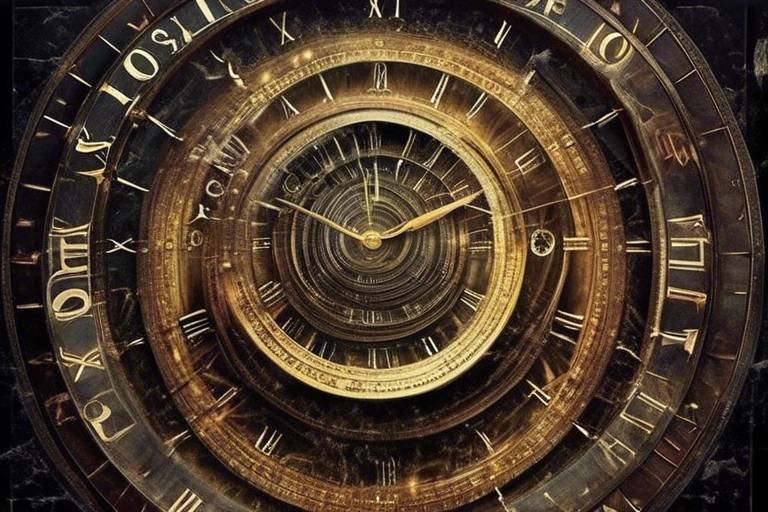
In the grand tapestry of existence, few threads are as intricate and captivating as the concepts of time and space. These two dimensions not only shape our reality but also influence our understanding of life itself. Imagine standing at the edge of a vast ocean, where the waves of time crash against the shores of space, creating a symphony of existence that is both beautiful and perplexing. In this exploration, we will dive deep into the philosophical underpinnings of time and space, unraveling their definitions, implications, and the profound ways they intertwine to form our understanding of reality.
The journey begins with time, a phenomenon that is as elusive as it is fundamental. What is time, really? Is it merely a measure of change, a ticking clock that governs our days, or is it something far more profound? Different cultures have perceived time in various ways, from the cyclical views of Eastern philosophies to the linear perspectives of Western thought. This divergence influences not only our daily lives but also the very foundations of philosophy and science. For instance, in many Indigenous cultures, time is viewed as a series of repeating cycles, where the past, present, and future are interconnected, contrasting sharply with the more segmented view prevalent in modern society.
As we transition to the concept of space, we find ourselves contemplating a vast expanse that serves as the backdrop for all physical phenomena. Space is not just an empty void; it is a dynamic entity that shapes our interactions with the universe. Think of space as the canvas upon which the painting of existence unfolds. Throughout history, our understanding of space has evolved dramatically, from the ancient Greeks who viewed it as a static entity to the revolutionary ideas introduced by Einstein, who suggested that space is intertwined with time in a four-dimensional fabric.
To further illustrate the complexity of time and space, let’s consider some key philosophical perspectives. Various thinkers have offered unique insights into the nature of these dimensions. For example, presentism argues that only the present moment is real, while eternalism posits that all moments—past, present, and future—exist simultaneously. This philosophical dichotomy raises intriguing questions about our perception of reality and the nature of existence itself.
Additionally, the block universe theory challenges traditional notions of time by suggesting that time is merely an unchanging four-dimensional block. This theory not only questions our understanding of time but also raises profound implications for concepts like free will and determinism. If all moments in time are equally real, do we have the power to change our future, or is everything predetermined?
Space, too, has its philosophical puzzles. Is space an entity in itself, or is it merely a relational concept defined by the objects within it? This debate has significant implications for our understanding of the universe. Some philosophers argue that space is a fundamental aspect of reality, while others contend that it is merely a byproduct of the relationships between objects. This ongoing discourse invites us to rethink our assumptions and consider the deeper implications of our spatial perceptions.
The interconnectedness of time and space is perhaps best exemplified in Einstein’s theory of relativity. This groundbreaking theory reshaped our understanding of both dimensions, illustrating how they interact and influence one another. According to relativity, time is not a constant; it can stretch and contract depending on speed and gravity. This revelation not only challenges our intuitive notions of time but also underscores the profound relationship between time and space.
Finally, we cannot overlook the intriguing concepts introduced by quantum mechanics. At the quantum level, time and space behave in ways that defy classical understanding. Particles can exist in multiple states simultaneously, leading to questions about the linearity of time and the nature of reality itself. Quantum theories invite us to reconsider the very fabric of existence, suggesting that our traditional views of time and space may be just the tip of the iceberg.
- What is the relationship between time and space?
Time and space are interconnected dimensions that shape our understanding of reality. Einstein’s theory of relativity illustrates how changes in one can affect the other. - How do different cultures perceive time?
Different cultures have unique interpretations of time, ranging from cyclical views to linear perspectives, influencing their philosophies and daily lives. - What is presentism?
Presentism is the philosophical view that only the present moment is real, while the past and future are not. - What is the block universe theory?
The block universe theory posits that time is an unchanging four-dimensional block, challenging traditional notions of time and free will.
Understanding Time
Time is one of those concepts that we often take for granted, yet it shapes our daily lives in profound ways. Imagine waking up in the morning; the moment your eyes open, you are already in a race against the clock. But what exactly is time? Is it merely a sequence of events, or does it hold a deeper, more philosophical significance? This question has puzzled thinkers across cultures and centuries, leading to various interpretations and understandings of this elusive dimension.
To start, let’s consider how different cultures perceive time. In many Western societies, time is viewed as linear—a straight line moving from the past, through the present, and into the future. This perspective aligns with our daily routines: we plan our schedules, set deadlines, and strive to make the most of every minute. However, in some Eastern cultures, time is perceived as cyclical, akin to the seasons that repeat year after year. This cyclical view invites a sense of harmony with nature, emphasizing the importance of the present moment over the relentless pursuit of future goals.
Philosophically, time has been interpreted in various ways. For instance, the ancient Greeks had two words for time: Chronos and Kairos. Chronos refers to chronological or sequential time, which is measurable and quantifiable. On the other hand, Kairos represents the opportune moment, the right time to act. This duality highlights that while we can measure time, its significance often lies in our personal experiences and the moments that shape our lives.
Moreover, the implications of time stretch into the realms of both philosophy and science. In physics, time is often treated as a fourth dimension, intertwined with the three dimensions of space. This intertwining was famously articulated by Albert Einstein in his theory of relativity, where he proposed that time is not a constant; it can stretch and contract based on speed and gravity. This revelation not only challenges our intuitive understanding of time but also raises questions about its fundamental nature. Is time something that exists independently of our perception, or is it merely a construct of our minds?
As we delve deeper into the philosophical perspectives on time, we encounter various theories that attempt to explain its nature. Some philosophers argue that only the present exists, a view known as presentism. Others contend that past, present, and future are equally real, a perspective referred to as eternalism. Each of these theories carries significant implications for how we understand our existence and our place in the universe.
In conclusion, time is not just a ticking clock or a calendar with dates. It is a complex and multifaceted concept that influences our lives, thoughts, and even our understanding of reality. As we continue to explore the philosophical implications of time, we uncover layers of meaning that challenge our perceptions and invite us to reflect on our existence in a deeper way.
- What is the difference between chronological and experiential time? Chronological time is the measurable, linear time we use for scheduling, while experiential time is subjective and varies based on our experiences.
- How do different cultures view time? Some cultures see time as linear, while others view it as cyclical, affecting their approach to life and priorities.
- What are presentism and eternalism? Presentism asserts that only the present is real, while eternalism posits that past, present, and future are equally real.
Understanding Space
Space is not just an empty void; it is the very canvas upon which the universe paints its phenomena. Imagine standing in a vast field, looking up at the stars. Each twinkling point of light is not merely a decoration but a representation of the complex interactions that occur within the cosmos. This section will delve into the definition of space, its dimensions, and how our perception of space has evolved throughout history, shaping both our scientific understanding and philosophical inquiry.
Historically, space has been viewed through various lenses. In ancient times, philosophers like Aristotle considered space to be a substance, a container for physical objects. Fast forward to the Enlightenment, and figures such as Isaac Newton began to view space as an absolute entity, a stage where events unfold independently of the objects within it. However, this perspective shifted dramatically with the advent of Einstein’s theory of relativity, which proposed that space is not merely a passive backdrop but is intertwined with time, forming a dynamic fabric known as spacetime.
To better understand this evolution, let’s break down the dimensions of space. Typically, we think of space in three dimensions—length, width, and height. However, the concept of space can extend beyond these dimensions. In theoretical physics, especially in string theory, additional dimensions are proposed, leading to a more complex understanding of the universe. Here’s a simple table to illustrate these dimensions:
| Dimension | Description |
|---|---|
| 1D | Line – only length |
| 2D | Plane – length and width |
| 3D | Space – length, width, and height |
| 4D | Spacetime – incorporates time as a dimension |
| Higher Dimensions | Proposed in string theory and other advanced theories |
As we explore these dimensions, it becomes clear that our perception of space is not static; it is a fluid concept shaped by advancements in science and philosophy. For instance, the idea that space can be curved, as suggested by general relativity, challenges our traditional views and prompts us to rethink our understanding of distance and proximity. Just as a sheet of paper can be folded, creating shortcuts between points, the fabric of space can bend and warp, leading to fascinating implications for travel and communication across vast distances.
Moreover, the cultural interpretations of space also play a significant role in shaping our understanding. Different societies have unique ways of perceiving and interacting with space. For example, Indigenous cultures often view space as interconnected and sacred, emphasizing a relationship with the land that transcends mere physicality. In contrast, modern urban societies may see space primarily as a commodity, something to be bought, sold, and developed. This dichotomy illustrates how our understanding of space is not only a scientific endeavor but also a deeply philosophical and cultural one.
In summary, space is far more than just an empty void; it is a complex and dynamic entity that influences our reality. As we continue to explore the nature of space, we uncover layers of meaning that challenge our perceptions and inspire us to think beyond the conventional. The interplay of science, philosophy, and culture enriches our understanding, inviting us to ponder the fundamental questions of existence and our place within the universe.
- What is the definition of space? Space refers to the boundless three-dimensional extent in which objects and events occur and have relative position and direction.
- How has our understanding of space changed over time? Our understanding of space has evolved from viewing it as a static entity to recognizing it as a dynamic aspect of the universe intertwined with time.
- What are higher dimensions in space? Higher dimensions refer to dimensions beyond the conventional three, proposed in theories such as string theory, suggesting additional spatial dimensions that we cannot perceive directly.
Philosophical Perspectives on Time
When we dive into the philosophical perspectives on time, we find ourselves navigating a complex landscape filled with intriguing theories and thought-provoking questions. Time, as we experience it, feels linear—like a river flowing from the past, through the present, and into the future. However, philosophers have long debated whether this perception holds true or if it’s merely an illusion crafted by our consciousness. One of the most compelling aspects of this discourse is how different schools of thought interpret the essence of time, leading to various implications for our understanding of reality.
To grasp the nuances of time, let’s explore some key philosophical theories:
- Presentism: This theory posits that only the present moment is real. According to presentists, the past is gone and the future is yet to be. They argue that our experiences and consciousness are anchored solely in the now, making it the only time frame that truly exists.
- Eternalism: In stark contrast, eternalism suggests that past, present, and future are all equally real. This perspective allows for a more expansive view of time, akin to a landscape where all moments coexist simultaneously, challenging our conventional understanding of temporal progression.
- The Block Universe Theory: This radical notion presents time as a four-dimensional block, where every moment exists in a static form, much like a film reel. According to this theory, the flow of time is an illusion, and all events are predetermined within this unchanging framework.
Each of these theories not only reshapes our understanding of time but also raises profound questions about free will and determinism. If presentism is correct, are we truly capable of change, or are we simply reacting to the present without influence from a predetermined past or future? On the other hand, if eternalism holds, does that imply that our choices are merely part of a larger tapestry, already woven into the fabric of existence?
Moreover, the block universe theory complicates our perception even further. If time is merely a dimension like space, where every moment exists simultaneously, what does that mean for our sense of agency? Are we merely actors playing out our roles in a script that has already been written? These questions are not just academic; they touch upon the very essence of human experience and consciousness.
In conclusion, the philosophical perspectives on time invite us to reflect on our understanding of existence itself. Whether we view time as a fleeting moment, a vast landscape, or a static block, each perspective offers unique insights that challenge our assumptions and deepen our inquiry into the nature of reality.
- What is presentism? Presentism is the belief that only the present moment is real, while the past is no longer existent and the future has yet to occur.
- How does eternalism differ from presentism? Eternalism posits that all points in time—past, present, and future—are equally real, contrasting with presentism’s focus on the present alone.
- What implications does the block universe theory have on free will? The block universe theory suggests that all moments exist simultaneously, which raises questions about the nature of free will and whether our choices are predetermined.
Presentism vs. Eternalism
When diving into the philosophical waters of time, we often find ourselves grappling with two dominant theories: presentism and eternalism. Each of these perspectives offers a unique lens through which we can examine our understanding of time, reality, and existence itself. So, what exactly do these terms mean, and how do they shape our perception of life? Let’s explore!
Presentism asserts that only the present moment is real. In this view, the past is merely a memory and the future is nothing but a collection of possibilities that have yet to unfold. Imagine standing on a busy street corner: the only moment that truly exists is the one in which you are standing there, feeling the breeze and hearing the sounds around you. Everything else—yesterday’s events or tomorrow’s plans—are just figments of your imagination. This perspective can feel comforting, as it emphasizes the importance of living in the moment and cherishing the here and now.
On the flip side, we have eternalism, which posits that past, present, and future are all equally real. Think of time as a vast, unchanging landscape, where every moment exists simultaneously, much like a book where every page is already written. In this view, every event that has ever happened or will ever happen is laid out before us in a grand tapestry of existence. This perspective can be quite mind-boggling, as it challenges our intuitive understanding of time as a flowing river where we can only navigate from one moment to the next.
The implications of these two theories extend beyond mere semantics; they touch upon our understanding of free will and determinism. If presentism is true, then our choices are significant because they shape the only moment that exists. However, if eternalism holds, then every decision we make is already part of a predetermined narrative, raising questions about the nature of choice itself. To illustrate this, consider the following table that summarizes the key differences between presentism and eternalism:
| Aspect | Presentism | Eternalism |
|---|---|---|
| Reality of Time | Only the present is real | Past, present, and future are equally real |
| Nature of Existence | Focus on the here and now | All moments exist simultaneously |
| Implications for Free Will | Choices shape reality | Choices are predetermined |
In conclusion, the debate between presentism and eternalism is not just an academic exercise; it profoundly influences how we view our lives and the decisions we make. Are we the architects of our reality, or are we simply players in a story that has already been written? This fundamental question invites us to reflect on our existence and the nature of time itself, ultimately enriching our understanding of the universe.
As we continue to ponder these theories, it’s essential to recognize that both presentism and eternalism offer valuable insights into the nature of time. Whether we lean towards the immediacy of the present or the vastness of the eternal, these perspectives challenge us to think deeply about our place in the cosmos.
The Block Universe Theory
The Block Universe Theory, often referred to as the “eternalism” perspective, presents a fascinating view of time that challenges our intuitive understanding of its flow. Imagine time as a vast, unchanging landscape, where every moment—past, present, and future—exists simultaneously within a four-dimensional block. This concept suggests that just as all points in space can be mapped out, so too can all moments in time be laid out in a single, comprehensive framework.
In this model, the past is not merely a series of events that have faded away; it is as real as the present moment we are experiencing right now. Similarly, the future is not an abstract idea waiting to unfold; it is already laid out in the fabric of the universe. This perspective raises significant questions about our perception of free will and determinism. If all moments in time are equally real, do we truly have the ability to change our future, or is it already determined within the block?
One of the most intriguing aspects of the Block Universe Theory is its implications for our understanding of causality and the nature of existence. In traditional views, we often think of time as a river, flowing from the past to the present and onward to the future. However, the Block Universe suggests that this flow is an illusion; instead, everything exists in a static state. This can be a challenging concept to grasp, as it fundamentally alters our perception of how we interact with time.
To illustrate this idea further, consider the following analogy: think of a movie reel. Each frame of the film represents a moment in time. When you watch the movie, you perceive the action unfolding in a linear manner. However, if you were to view the entire reel at once, you would see that all frames exist simultaneously. This is akin to how the Block Universe Theory posits that all moments exist together, challenging our traditional notions of time and sequence.
Critics of the Block Universe Theory argue that it undermines our lived experience of time, where we feel a clear distinction between past, present, and future. However, proponents assert that this theory provides a more coherent explanation of the universe’s structure, especially in light of modern physics. As we delve deeper into the realms of quantum mechanics and relativity, the Block Universe becomes increasingly relevant, prompting us to reconsider our fundamental beliefs about reality.
In conclusion, the Block Universe Theory invites us to rethink our understanding of time. It challenges the very essence of how we perceive our existence and the choices we make. As we explore the implications of this theory, we begin to see time not as a flowing river but as a vast, intricate tapestry, where every thread is woven together in a complex, unchanging design.
- What is the Block Universe Theory? – It is a philosophical concept suggesting that time is a four-dimensional block where all moments exist simultaneously.
- How does the Block Universe Theory relate to free will? – It raises questions about whether our future is predetermined since all moments are equally real.
- Can we change the past or future according to this theory? – In the Block Universe perspective, the past and future are already laid out, challenging the notion of changing them.
- What implications does this theory have for modern physics? – It aligns with certain interpretations of relativity and quantum mechanics, prompting a reevaluation of time’s nature.
Philosophical Perspectives on Space
When we think about space, it’s easy to picture the vastness of the universe, the stars, and the planets. But from a philosophical standpoint, space is a far more complex concept. Is space a physical entity in itself, or is it merely a framework in which objects exist? This question has intrigued philosophers for centuries. Historically, two main perspectives have emerged: absolute space and relational space.
Absolute space, as championed by Sir Isaac Newton, suggests that space exists independently of the objects within it. In this view, space is a container that holds everything, much like a theater that accommodates various performances. Imagine a stage where the actors (objects) perform their roles, but the stage itself remains unchanged. This idea implies that space has its own properties and dimensions, regardless of whether anything occupies it.
On the other hand, relational space, supported by philosophers like Gottfried Wilhelm Leibniz, argues that space is not an entity in itself but rather a relationship among objects. In this view, space only exists because there are objects to define it. For instance, think of a crowded room filled with people. The space is defined by the distance between individuals and their interactions. Without them, the concept of that space becomes meaningless. Thus, space is a product of the relationships and interactions that occur within it.
These philosophical perspectives on space have significant implications for our understanding of reality. They challenge us to consider how we perceive our surroundings and the universe at large. Are we merely observers in a vast, empty void, or are we part of a dynamic web of relationships that gives rise to the very notion of space? This inquiry leads us to further explore how space interacts with time, as they are often viewed as two sides of the same coin.
Additionally, the advent of modern physics has added layers of complexity to these philosophical discussions. With the theory of relativity, for instance, we learn that space is not a static entity but can warp and curve based on the mass of objects within it. This revelation aligns more closely with the relational perspective, suggesting that the fabric of space itself is influenced by the entities it contains.
As we navigate these philosophical waters, it’s essential to consider the implications of our understanding of space. Does it affect our perception of existence? How do our beliefs about space shape our experiences and interactions? These questions invite us to reflect on our place in the universe and the very nature of reality itself.
- What is absolute space? Absolute space is the concept that space exists independently of the objects within it, much like a container.
- What is relational space? Relational space posits that space is defined by the relationships and distances between objects, rather than existing as an independent entity.
- How does modern physics impact our understanding of space? Modern physics, particularly the theory of relativity, shows that space can warp and change based on the presence of mass, challenging traditional views of static space.
The Interconnectedness of Time and Space
When we think about time and space, it’s easy to imagine them as separate entities, like two parallel lines that never meet. However, the reality is far more intricate and fascinating. Time and space are not just companions; they are intertwined in a complex relationship that forms the very fabric of our universe. This connection is beautifully illustrated by Einstein’s theory of relativity, which fundamentally changed our understanding of both dimensions.
At the heart of this interconnectedness is the concept that time cannot exist without space and vice versa. Imagine a stage where a play is performed: the actors (events) need a stage (space) to perform, and the duration of the play (time) is crucial for the story to unfold. Similarly, in our universe, events occur within a spatial framework and are bound by the flow of time. This relationship raises intriguing questions about how we perceive reality. Are we merely spectators in a vast cosmic theater, or do we have an active role in shaping the narrative?
Einstein proposed that time and space form a single continuum known as spacetime. This revolutionary idea means that the dimensions we experience are not isolated but rather part of a unified whole. In this four-dimensional fabric, the curvature of spacetime is influenced by mass and energy, leading to phenomena such as gravity. To put it simply, massive objects like planets and stars warp the spacetime around them, causing the paths of nearby objects to bend. This is why, for instance, the Earth orbits the Sun—not just because of the Sun’s gravitational pull, but because the Sun is altering the very geometry of space and time around it.
Furthermore, the interconnectedness of time and space has profound implications for our understanding of the universe. It challenges our intuitive notions of absolute time and absolute space, suggesting instead that our measurements of time can vary depending on our position in space and our relative velocity. This leads to phenomena like time dilation, where time appears to pass more slowly for an object moving at high speeds compared to one at rest. It’s as if time is flexible, bending and stretching depending on the circumstances—much like a rubber band being pulled in different directions.
To illustrate this further, consider the following table that summarizes key aspects of the relationship between time and space:
| Aspect | Time | Space |
|---|---|---|
| Definition | A measure of the duration of events | The three-dimensional extent in which objects exist |
| Interdependence | Cannot exist without space | Cannot exist without time |
| Influence | Affected by speed and gravity | Affected by mass and energy |
| Philosophical Implications | Challenges notions of past, present, and future | Questions the nature of existence and reality |
This intricate dance between time and space not only shapes our physical reality but also invites us to ponder deeper metaphysical questions. For instance, if time is flexible and space is malleable, what does that say about our perception of existence? Are we bound by the linear progression of time, or can we transcend it in ways we have yet to understand? These questions fuel philosophical debates and scientific inquiries alike, pushing the boundaries of what we know.
In conclusion, the interconnectedness of time and space is a profound concept that challenges our understanding of reality. It invites us to explore the universe not just as a collection of objects and events but as a dynamic interplay of dimensions that shape our existence. As we continue to unravel the mysteries of spacetime, we may discover that the universe is far more interconnected and intricate than we ever imagined.
- What is spacetime? Spacetime is the four-dimensional continuum that combines the three dimensions of space with the dimension of time, forming the framework in which all physical events occur.
- How does gravity affect time? According to relativity, the stronger the gravitational field, the slower time passes relative to a weaker field. This phenomenon is known as time dilation.
- Can time travel exist? While time travel remains a theoretical concept, certain interpretations of physics suggest it may be possible under specific conditions, such as near a black hole or through wormholes.
Relativity and Its Implications
The theory of relativity, proposed by Albert Einstein in the early 20th century, fundamentally altered our understanding of time and space. Before relativity, time and space were often viewed as separate, absolute entities. However, Einstein’s groundbreaking work revealed that they are intertwined in a complex relationship, forming what we now refer to as spacetime. This concept suggests that the fabric of the universe is not just a mere backdrop but an active participant in the events that unfold within it.
At its core, relativity presents two key theories: special relativity and general relativity. Special relativity focuses on the physics of objects moving at constant speeds, particularly those approaching the speed of light. One of its most famous implications is the idea that time can dilate; that is, time can pass at different rates for observers in different frames of reference. Imagine two twins: one stays on Earth while the other travels through space at near-light speed. Upon returning, the traveling twin would find they have aged less than their Earth-bound sibling. This phenomenon, known as the twin paradox, challenges our intuitive understanding of time as a constant.
On the other hand, general relativity expands these ideas to include acceleration and gravity. Einstein proposed that massive objects, like planets and stars, warp the spacetime around them, creating what we perceive as gravitational attraction. To visualize this, think of a heavy ball placed on a trampoline; it creates a dip that affects smaller balls nearby, causing them to roll toward it. This analogy illustrates how gravity is not merely a force but a curvature of spacetime itself.
The implications of relativity extend far beyond theoretical physics. For instance, it has practical applications in technologies we use daily. The Global Positioning System (GPS), which allows us to navigate with precision, relies on adjustments for both time dilation due to the satellites’ speed and the gravitational effects of Earth. Without accounting for these relativistic effects, our GPS readings would quickly become inaccurate, leading to significant navigational errors.
Furthermore, relativity has profound philosophical implications. It challenges our perception of reality, suggesting that time and space are not as straightforward as we once believed. The idea that time can be experienced differently depending on one’s position and velocity prompts us to reconsider our notions of reality and existence. Are we merely passengers on a linear timeline, or is our experience of time more akin to a rich tapestry woven from the threads of our unique perspectives?
In conclusion, Einstein’s theory of relativity reshapes our understanding of time and space, revealing them to be dynamic and interconnected. It invites us to explore the universe with an open mind, questioning our preconceived notions and embracing the complexities of reality. As we continue to investigate the implications of relativity, we find ourselves on a journey that not only expands our scientific knowledge but also enriches our philosophical inquiry into the nature of existence itself.
- What is the main idea of special relativity?
Special relativity asserts that the laws of physics are the same for all observers, regardless of their relative motion, and introduces the concept of time dilation. - How does general relativity explain gravity?
General relativity posits that massive objects curve spacetime, causing other objects to move toward them, which we perceive as gravitational attraction. - What are some real-world applications of relativity?
Applications like GPS technology rely on adjustments for relativistic effects to provide accurate location data.
Time-Space in Quantum Mechanics
When we dive into the world of quantum mechanics, we enter a realm that challenges our traditional understanding of both time and space. Imagine a universe where particles can exist in multiple states simultaneously, where the act of observation can alter the state of reality itself. This is the strange, yet fascinating, domain of quantum physics, where time and space are not just the stages for events to unfold but are intricately woven into the very fabric of existence.
One of the most intriguing aspects of quantum mechanics is the concept of superposition. In simple terms, superposition allows particles to exist in multiple states at once until they are observed. This raises profound questions about the nature of time. Does time flow in a linear fashion, or is it possible that all moments—past, present, and future—coexist in a timeless state? Quantum mechanics seems to suggest the latter, hinting that our perception of time may be more of a construct than an absolute reality.
Furthermore, the phenomenon known as entanglement adds another layer of complexity. When two particles become entangled, the state of one instantly influences the state of the other, regardless of the distance separating them. This challenges the classical notion of space as a mere container for objects. Instead, it suggests that space might be more like a network of connections, where distance becomes irrelevant in the face of quantum relationships. What does this mean for our understanding of time and space? It implies that they may not be separate entities but rather intertwined aspects of a larger, more complex reality.
To better illustrate these concepts, consider the following table that summarizes key differences between classical and quantum views of time and space:
| Aspect | Classical View | Quantum View |
|---|---|---|
| Nature of Time | Linear and absolute | Non-linear and potentially simultaneous |
| Nature of Space | Fixed and separable | Interconnected and relational |
| Measurement | Independent of observer | Dependent on observation |
As we grapple with these mind-bending ideas, it becomes clear that quantum mechanics invites us to reconsider our foundational beliefs about reality. Are time and space merely illusions, or do they hold deeper truths waiting to be uncovered? The answers may lie in the heart of quantum theory, where the boundaries of time and space blur, and the possibilities of existence become as limitless as our imagination.
In conclusion, the exploration of time and space through the lens of quantum mechanics not only broadens our understanding of the universe but also challenges us to rethink our place within it. As we continue to unravel these mysteries, one thing is certain: the journey into the quantum realm is just beginning, and the implications for our understanding of reality are as profound as they are exciting.
- What is quantum entanglement? Quantum entanglement is a phenomenon where two particles become linked and the state of one particle instantly influences the state of the other, regardless of the distance between them.
- How does superposition relate to time? Superposition allows particles to exist in multiple states simultaneously, suggesting that our perception of time may be more complex than a simple linear progression.
- Can quantum mechanics change our understanding of reality? Yes, quantum mechanics challenges traditional notions of time and space, prompting us to reconsider what we know about the universe and our place within it.
Frequently Asked Questions
- What is the nature of time?
Time is often perceived as a linear progression of moments, but its nature is much more complex. Philosophers and scientists alike explore various interpretations, such as time being an illusion or a fundamental aspect of the universe. Different cultures also have unique perspectives on time, influencing how we understand our existence and reality.
- How do presentism and eternalism differ?
Presentism posits that only the present moment is real, while eternalism suggests that past, present, and future events are equally real. This philosophical debate has profound implications on our understanding of time, influencing concepts of memory, experience, and even free will.
- What is the block universe theory?
The block universe theory proposes that time is a four-dimensional block where all moments exist simultaneously. This challenges traditional views of time as a flowing river, raising questions about determinism and the nature of free will.
- How has our understanding of space evolved?
Space serves as the backdrop for all physical phenomena, and our understanding of it has evolved significantly over time. From Newton’s absolute space to Einstein’s relativity, our perception of space has transformed, leading to new philosophical inquiries about its true nature.
- What is the relationship between time and space?
Time and space are intricately linked, often referred to as spacetime. Einstein’s theory of relativity illustrates how these dimensions interact, showing that the fabric of the universe is not just a static stage but a dynamic interplay that shapes our reality.
- How does quantum mechanics challenge classical views of time and space?
Quantum mechanics introduces concepts that defy classical interpretations of time and space, such as superposition and entanglement. These phenomena suggest that our understanding of reality is far more complex than previously thought, prompting new philosophical discussions about the nature of existence.
Metaphysics, Time, Space, Ontology, Reality, Causality, Perception, Existence, , Metaphysics, Time, Space, Ontology, Reality, Causality, Perception, Existence,
Share this content:
Leave a Reply