
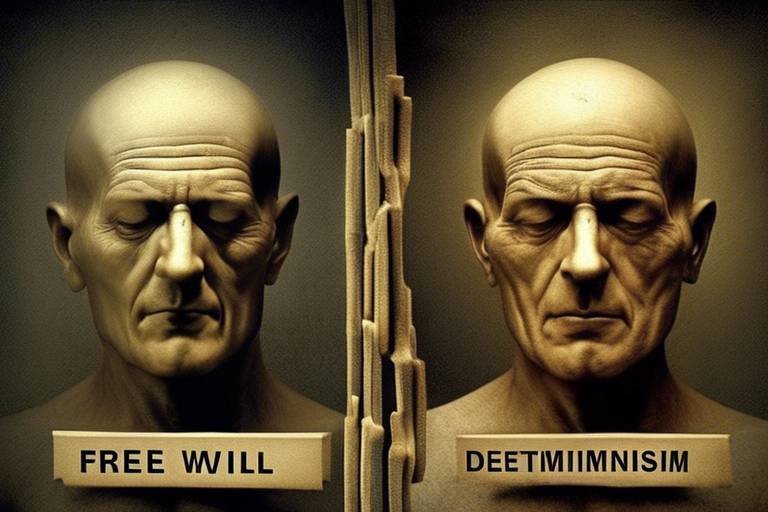
The debate between free will and determinism has captivated thinkers for centuries, igniting discussions that traverse the realms of philosophy, psychology, and even science. At its core, this inquiry asks whether we are truly the architects of our own actions or merely puppets dancing to the strings of fate. Imagine standing at a crossroads, where every choice you make could lead you down a different path. But what if those paths were already laid out before you, dictated by a series of prior events? This tension between the freedom to choose and the constraints of causality creates a rich tapestry of thought that challenges our understanding of human behavior, morality, and accountability.
As we embark on this philosophical journey, we will delve into the definitions and implications of both concepts. Free will suggests that individuals possess the inherent ability to make choices independent of external influences. This perspective emphasizes personal responsibility, making us accountable for our actions. On the other hand, determinism posits that every event, including human actions, is the result of preceding events and natural laws, raising questions about the very nature of choice itself. Are we truly free, or are our decisions merely the byproducts of a complex web of causation?
To further enrich our understanding, we will explore various philosophical perspectives that have emerged over time. From the ancient Greeks to modern thinkers, the discourse surrounding free will and determinism has evolved, presenting compelling arguments that either bridge the two concepts or highlight their incompatibilities. As we dissect these viewpoints, we will also consider the moral implications of each stance. How do our beliefs about free will and determinism shape our understanding of ethics, justice, and societal norms?
Ultimately, this inquiry invites us to reflect on our own lives. Are we the masters of our destiny, or are we merely navigating a course charted by forces beyond our control? The answers may not be straightforward, but the exploration of these profound questions is essential for grasping the complexities of human existence. So, buckle up as we dive deeper into this philosophical labyrinth, where every turn offers new insights and challenges our preconceived notions.
- What is free will? Free will is the ability to make choices that are not constrained by external factors, emphasizing individual autonomy and moral responsibility.
- What is determinism? Determinism is the philosophical view that every event, including human actions, is determined by preceding events and natural laws.
- Can free will and determinism coexist? This question has been a topic of debate among philosophers, with some arguing for compatibilism, which suggests that free will and determinism can coexist harmoniously.
- How do these concepts affect moral responsibility? The belief in free will typically supports the notion of moral responsibility, while determinism raises questions about accountability for actions.
- What are the implications of these ideas on society? The concepts of free will and determinism influence legal systems, societal norms, and our understanding of human behavior.
Understanding Free Will
Free will is a concept that has captivated philosophers, theologians, and everyday individuals for centuries. At its core, free will represents the ability to make choices that are not entirely constrained by external influences or predetermined factors. Imagine standing at a crossroads, where each path represents a different choice; the ability to choose your direction is what free will embodies. But is that choice truly ours, or is it merely an illusion shaped by various forces around us?
The significance of free will cannot be overstated. It shapes our understanding of individual responsibility and moral accountability. When we believe we have the power to make our own choices, it follows that we should also be held accountable for those choices. This belief is foundational to our legal systems and societal norms. For instance, if someone commits a crime, the assumption is that they had the option not to do so. But what if their choices were influenced by factors beyond their control, such as upbringing or societal pressures? This dilemma leads us to question the very nature of our decisions.
Moreover, free will is often tied to our sense of identity. We like to think of ourselves as autonomous beings capable of acting according to our desires and intentions. This perspective fosters a sense of empowerment, as individuals feel they can shape their destinies. However, this empowerment can also lead to anxiety. The weight of choice can feel overwhelming, especially when the outcomes of our decisions are uncertain. In this sense, free will can be both a gift and a burden.
In philosophical discussions, the debate surrounding free will often intersects with concepts like determinism. While free will suggests that we are the architects of our choices, determinism posits that every event, including human actions, is the result of preceding events and natural laws. This raises the question: if our choices are predetermined, can we truly claim to be free? The tension between these two perspectives invites a rich exploration of human behavior and ethics.
To further understand free will, it’s essential to consider the various factors that influence our decision-making processes. These include:
- Biological Factors: Genetics and brain chemistry can significantly impact our choices.
- Psychological Influences: Our thoughts, emotions, and mental health shape the way we perceive options.
- Social Environment: Family, culture, and societal norms play crucial roles in guiding our decisions.
In conclusion, free will is a multifaceted concept that invites us to reflect on our choices, responsibilities, and the essence of our humanity. It challenges us to consider how much control we truly have over our lives and the implications of that control on our moral frameworks. As we delve deeper into the philosophical inquiry of free will versus determinism, we uncover layers of complexity that not only shape our understanding of ourselves but also influence the fabric of society itself.
Exploring Determinism
Determinism is a philosophical concept that suggests that every event, including human actions, is determined by preceding events and natural laws. Imagine a massive chain reaction where one event triggers another in a seamless flow; that’s the essence of determinism. It raises some fascinating questions about our sense of control and autonomy. Are we merely puppets dancing on strings pulled by fate, or do we have any say in our own destinies? This inquiry is not just academic; it has profound implications for how we understand ourselves and our place in the universe.
At its core, determinism challenges the very idea of free will. If every choice we make is the result of prior causes, can we truly claim to be the authors of our own lives? This concept can feel unsettling. Think about it: if everything we do is preordained by a series of events that stretch back to the beginning of time, where does that leave our sense of agency? It’s a bit like being in a choose-your-own-adventure book where every path has already been written out for you. The illusion of choice becomes just that—an illusion.
One of the most intriguing aspects of determinism is how it intersects with various fields, from science to ethics. For instance, in the realm of neuroscience, studies have shown that our brains often make decisions before we consciously realize it. This suggests that our sense of making a choice is more of a post-hoc rationalization than an actual decision-making process. It’s like when you think you’ve decided to eat dessert, but your brain had already made that choice before you even reached for the spoon!
Moreover, determinism isn’t a monolithic concept; it comes in different flavors. Here are a few key types:
- Causal Determinism: Every event is the result of prior events. This is the most straightforward form, where cause and effect reign supreme.
- Logical Determinism: This suggests that propositions about the future are already true or false, meaning the future is already determined.
- Theological Determinism: This posits that a divine being has predetermined every event, including human actions, based on omniscience.
Each of these forms of determinism presents unique challenges to the notion of free will. For instance, causal determinism raises questions about moral responsibility—if our actions are predetermined, can we be held accountable for them? This dilemma becomes even more complex when we consider theological determinism, which intertwines divine foreknowledge with human behavior. If a deity knows what we will do before we do it, are we truly free to choose otherwise?
As we explore determinism, it’s essential to recognize that it doesn’t just affect philosophical debates; it also has real-world implications. Our legal systems, societal norms, and even personal relationships can be influenced by how we interpret free will and determinism. If we lean heavily into a deterministic worldview, it might lead us to a more compassionate understanding of human behavior, emphasizing rehabilitation over punishment. Conversely, a strict belief in free will might push us to hold individuals entirely accountable for their actions, regardless of their circumstances.
In conclusion, exploring determinism invites us to question the very fabric of human existence. It pushes us to confront uncomfortable truths about choice, responsibility, and the nature of reality itself. As we continue to unravel these philosophical threads, we must ask ourselves: Do we embrace the chaos of free will, or do we find solace in the structured predictability of determinism? The answer may not be as clear-cut as we hope, but the journey of exploration is what truly enriches our understanding of ourselves and the world around us.
Types of Determinism
When diving into the intricate world of determinism, it becomes essential to recognize that this philosophical stance is not monolithic. Instead, it branches into several distinct types, each with its nuances and implications. Understanding these types can illuminate the debate surrounding free will and moral responsibility, helping us grasp the broader implications of our choices and actions. Let’s explore the three primary forms of determinism: causal determinism, logical determinism, and theological determinism.
Causal determinism is perhaps the most widely discussed type. It posits that every event or action is the result of preceding events in accordance with the laws of nature. Imagine a row of dominoes: when one falls, it inevitably causes the next to tumble. This chain reaction suggests that if we could trace back through time, we would find that every decision we make is the outcome of prior states of the universe. In this framework, the idea of free will becomes murky, as it raises the question: if our choices are merely the results of prior causes, can we truly be held accountable for them?
Next, we encounter logical determinism, which deals with the realm of propositions and their truth values. This form of determinism asserts that all propositions about the future are either true or false, regardless of whether we have the ability to affect those outcomes. For instance, if it is true that “it will rain tomorrow,” then it is predetermined that it will rain, regardless of our actions. This raises intriguing questions about the nature of truth and our perception of time. Are our choices merely illusions if the future is already set in stone?
Lastly, theological determinism introduces a divine element to the discussion. This perspective suggests that if a deity possesses omniscience—complete knowledge of all events, past, present, and future—then human actions are predetermined by this divine foreknowledge. This notion can be particularly challenging for believers, as it brings forth the dilemma of reconciling divine omniscience with human free will. If God already knows the choices we will make, are those choices truly ours? The intersection of faith and philosophy in this context leads to profound questions about morality and accountability.
Understanding these types of determinism not only enriches our grasp of philosophical debates but also prompts us to reflect on our own beliefs about choice and accountability. Each type presents unique challenges to the concept of free will, compelling us to examine the very nature of our decisions and the frameworks within which we operate. As we navigate through these complex ideas, it becomes clear that the discussion surrounding free will and determinism is far from settled; rather, it remains a vibrant area of inquiry, continually inviting us to ponder the essence of human existence.
- What is the main difference between free will and determinism?
Free will suggests that individuals can make choices independent of external constraints, whereas determinism argues that every event is the result of preceding factors and laws. - Can determinism coexist with free will?
This is a contentious issue in philosophy. Some argue for compatibilism, which posits that free will can exist even if determinism is true. - How does causal determinism affect moral responsibility?
If our actions are predetermined by past events, some argue that it undermines our moral responsibility for those actions.
Causal Determinism
Causal determinism is a fascinating concept that suggests every event, including human actions, is the result of preceding events in accordance with the laws of nature. Imagine a giant domino effect, where each piece represents an event that inevitably leads to the next. This perspective implies that if we could know all the variables at play, we could predict future actions and events with absolute certainty. But what does this mean for our understanding of free will? Are we merely puppets dancing on strings pulled by the past?
At its core, causal determinism challenges the notion of individual agency. If every decision we make stems from a chain of prior occurrences, how much control do we truly have? This leads to a profound philosophical inquiry into the nature of choice and accountability. If someone commits a crime, can we hold them fully responsible if their actions were predetermined by their upbringing, genetics, or even past experiences? This question ignites heated debates about justice and moral responsibility.
To better understand causal determinism, let’s break down its implications. Here are some key points to consider:
- Predictability: If every action is determined, theoretically, we could predict human behavior with enough information.
- Responsibility: How do we assign blame or praise if our actions are merely the result of prior causes?
- Human Behavior: Causal determinism can lead to a more sympathetic view of human actions, understanding them as products of circumstances rather than moral failings.
Philosophers like David Hume and Baruch Spinoza have contributed significantly to this discussion. Hume argued that while we may feel as though we are making free choices, our decisions are often influenced by our desires and experiences, which are themselves determined by prior events. On the other hand, Spinoza took a more radical approach, suggesting that understanding the deterministic nature of the universe can lead to greater emotional freedom and peace of mind.
In summary, causal determinism opens a Pandora’s box of questions about human nature and morality. It forces us to reconsider the very foundations of our ethical frameworks and our understanding of justice. Are we truly free, or are we simply following a script written by the universe? This inquiry not only challenges our perceptions of free will but also invites us to delve deeper into the essence of what it means to be human.
Theological Determinism
Theological determinism is a fascinating concept that intertwines the realms of philosophy and theology, positing that divine foreknowledge dictates human actions. Imagine a grand cosmic script where every thought, choice, and action is pre-written by an omniscient deity. This perspective raises profound questions about the nature of free will and moral responsibility. If God knows everything that will happen, does that mean our choices are merely illusions? Are we puppets dancing to a divine tune, or do we still hold the strings of our own decisions?
At its core, theological determinism suggests that God’s omniscience and omnipotence are fundamentally linked to the fate of humanity. This belief can be traced back to various religious traditions, where the idea of a preordained plan for each individual is prevalent. For instance, in Christianity, the doctrine of predestination asserts that God has already chosen who will be saved and who will not, leading to the question: if our ultimate fate is sealed, how can we claim to have genuine free will?
To better understand theological determinism, consider the following key points:
- Divine Foreknowledge: The belief that God knows the future perfectly, including every action and decision made by individuals.
- Predestination: The idea that God has predetermined the eternal destiny of every person, which can lead to debates about human agency.
- Moral Responsibility: If our actions are preordained, can we be held accountable for them? This question challenges traditional views on ethics and justice.
Critics of theological determinism argue that it undermines the very essence of moral responsibility. If every action is a result of divine foreknowledge, then how can we truly be held accountable for our choices? This dilemma creates a tension between the belief in a just and loving God and the implications of predestination. Some theologians suggest that God’s foreknowledge does not negate human free will; rather, it coexists with it in a mysterious way. This perspective opens up a dialogue about the compatibility of divine sovereignty and human autonomy.
Moreover, theological determinism also poses challenges for the concept of prayer and divine intervention. If all events are predetermined, what role does prayer play in influencing outcomes? Does it serve merely as a means of aligning oneself with God’s will, or can it genuinely alter the course of events? These questions invite deep reflection and discussion, as they touch on the very nature of faith and the human experience.
In summary, theological determinism presents a complex interplay between divine foreknowledge and human action. It challenges us to reconsider our understanding of free will, morality, and accountability. As we navigate these philosophical waters, we must grapple with the implications of a predetermined existence while seeking to understand the divine nature that governs our lives. The conversation surrounding theological determinism remains vibrant and relevant, urging us to explore the depths of our beliefs and the nature of our choices.
- What is theological determinism? It is the belief that God’s foreknowledge determines human actions and choices.
- Does theological determinism negate free will? This is a debated topic; some argue it does, while others believe both can coexist.
- How does predestination relate to moral responsibility? If actions are predetermined, it raises questions about accountability and ethics.
Philosophical Perspectives
The debate surrounding free will and determinism has captivated philosophers for centuries, leading to a rich tapestry of perspectives that examine the nature of human agency and the universe’s structure. At its core, this discussion raises profound questions: Are we truly the architects of our own choices, or are our decisions merely the byproducts of a predetermined cosmic script? This inquiry invites us to consider various philosophical stances, each offering unique insights into the interplay between freedom and determinism.
One of the most significant philosophical positions is compatibilism, which suggests that free will and determinism can coexist harmoniously. Compatibilists argue that even if our choices are influenced by prior causes, we still possess the ability to act according to our desires and intentions. In this view, free will is not about being free from causation but rather about acting in accordance with one’s motivations. Think of it like a river: while the water flows in a predetermined direction, it still moves freely within its banks. This perspective allows for a nuanced understanding of moral responsibility, as individuals can still be held accountable for their actions, even if those actions are influenced by external factors.
In contrast, incompatibilism posits that free will and determinism are fundamentally at odds. Incompatibilists argue that if our actions are determined by prior events, we cannot truly be said to have free will. This perspective often leads to a more fatalistic outlook on life, suggesting that our choices are mere illusions. Think of it like a puppet show: if the strings are pulled by unseen forces, the puppets can’t claim to be making their own decisions. This raises challenging questions about moral accountability, as it may seem unjust to hold individuals responsible for actions that were never genuinely their own.
Within the realm of incompatibilism, we also encounter libertarianism, which asserts that humans possess genuine free will that is not constrained by determinism. Libertarians argue that individuals can make choices that are not entirely dictated by prior causes, emphasizing the importance of autonomy and personal agency. This perspective often draws on existentialist themes, where the emphasis is placed on individual choice and the inherent responsibility that comes with it. The libertarian view can be empowering, as it champions the idea that we are the captains of our own ships, navigating through life’s turbulent waters.
Moreover, the philosophical landscape is enriched by existentialist thinkers, such as Jean-Paul Sartre, who vehemently championed the idea of radical freedom. Sartre argued that existence precedes essence, meaning that individuals are not born with a predetermined nature but rather create their essence through choices. This radical approach to free will emphasizes the weight of responsibility on individuals, as they must confront the consequences of their actions without the comfort of external justification. It’s a bit like being thrown into the deep end of a pool—there’s no choice but to swim, and how well you do is entirely up to you.
Finally, we can’t overlook the contributions of stoicism, which offers a different lens through which to view the free will versus determinism debate. Stoics believe in accepting the things we cannot control while taking responsibility for our reactions and choices. This philosophy teaches that while many aspects of life are determined by fate, our responses to those events are where our true freedom lies. It’s akin to being dealt a hand of cards: while you can’t choose the cards you receive, you can choose how you play them. This perspective encourages resilience and personal growth, highlighting the importance of internal agency even in a seemingly deterministic world.
In summary, the philosophical perspectives on free will and determinism provide a rich framework for understanding human behavior and morality. Whether one leans towards compatibilism, libertarianism, or another viewpoint, the implications of these beliefs shape our understanding of accountability, ethics, and the very essence of what it means to be human. As we navigate this complex debate, it becomes clear that the questions surrounding free will and determinism are not just academic; they resonate deeply with our everyday lives and the choices we make.
- What is free will? Free will refers to the ability to make choices that are not constrained by external factors.
- What is determinism? Determinism is the philosophical idea that every event, including human actions, is determined by preceding events and natural laws.
- Can free will and determinism coexist? Yes, some philosophers argue for compatibilism, which suggests that free will can exist within a deterministic framework.
- What is libertarianism in the context of free will? Libertarianism asserts that individuals have genuine free will that is not determined by prior causes.
- How do these concepts affect moral responsibility? The beliefs in free will or determinism significantly influence how we perceive moral accountability and justice.
The Moral Implications
The debate between free will and determinism is not just a philosophical exercise; it has profound moral implications that ripple through our understanding of ethics and accountability. When we ponder whether our choices are genuinely ours or predetermined by a series of prior events, we inevitably confront questions that challenge the very foundation of our moral framework. For instance, if we accept that every action we take is the result of preceding causes, can we still hold individuals accountable for their actions? This question is at the heart of the moral implications of this debate.
Consider this: if someone commits a crime, and we believe that their actions were determined by their upbringing, genetics, or environmental factors, does that absolve them of responsibility? Or does it simply mean that we need to rethink how we approach justice and rehabilitation? The implications stretch far beyond individual cases, affecting our legal systems and societal norms. In a world where determinism reigns supreme, we might lean towards a more compassionate approach to crime, focusing on rehabilitation rather than punishment.
To illustrate this point, let’s break down some key moral considerations:
- Accountability: If we believe in free will, we are more likely to hold individuals accountable for their choices. This belief underpins our legal systems, where individuals are judged based on their intentions and actions.
- Compassion: In a deterministic framework, we might cultivate a sense of compassion for those who commit wrongful acts, recognizing that their choices were not entirely their own.
- Ethical Responsibility: The belief in free will encourages a sense of ethical responsibility, prompting individuals to reflect on their actions and the impact they have on others.
Moreover, these contrasting views can lead to significant differences in how we approach moral education. If we lean towards a deterministic perspective, we might prioritize teaching empathy and understanding of external influences on behavior rather than simply instilling a sense of right and wrong. This could foster a society that values rehabilitation and second chances, rather than one that punishes without consideration of underlying causes.
As we navigate these moral waters, it’s essential to recognize that the implications of free will and determinism are far-reaching. They influence how we perceive justice, shape our societal norms, and even impact our personal relationships. For example, when we experience conflict with others, do we attribute their actions to their character (implying free will), or do we consider their circumstances (leaning towards determinism)? This distinction can profoundly affect our responses and interactions.
In conclusion, the moral implications of free will versus determinism are complex and multifaceted. They challenge us to reconsider our beliefs about accountability, justice, and the nature of human behavior. As we continue to explore these philosophical questions, we must remain open to the possibility that both perspectives may offer valuable insights into the human experience.
- What is free will? Free will is the ability to make choices without external constraints, allowing individuals to act according to their own desires and reasoning.
- What is determinism? Determinism is the philosophical belief that all events, including human actions, are determined by preceding events and natural laws.
- How do free will and determinism affect moral responsibility? The belief in free will typically supports the notion of moral responsibility, while determinism raises questions about accountability and the nature of choice.
- Can both concepts coexist? Some philosophers argue for compatibilism, suggesting that free will and determinism can coexist, allowing for moral responsibility within a deterministic framework.
Responsibility and Accountability
The concepts of responsibility and accountability are intricately linked to the ongoing debate between free will and determinism. When we talk about responsibility, we often think about the choices we make and the consequences that follow. But what happens when we dive deeper into the philosophical waters of free will and determinism? Are we truly responsible for our actions, or are we merely products of our environment, biology, and circumstances?
To understand this complex relationship, we must first consider how free will influences our perception of responsibility. If we believe in free will, we tend to think that individuals have the power to make choices independent of external influences. This belief fosters a sense of moral accountability, where people are praised or blamed for their actions. For instance, when someone commits a crime, the common reaction is to hold them accountable, assuming they had the freedom to choose otherwise. This perspective is crucial in forming the foundation of our legal systems and societal norms.
On the flip side, determinism challenges this notion. If every action is predetermined by previous events, then the idea of personal accountability becomes murky. Imagine a domino effect where one event leads to another in a chain reaction; if we are merely the last domino in this sequence, can we truly be held responsible for our actions? This philosophical quandary raises significant questions about justice and punishment. Should we punish someone for a crime if their actions were dictated by factors beyond their control, such as genetics or upbringing?
To illustrate this further, consider the following table that summarizes the implications of both perspectives on responsibility:
| Perspective | Implications for Responsibility |
|---|---|
| Free Will | Individuals are accountable for their choices; moral praise and blame are justified. |
| Determinism | Actions are the result of prior events; accountability may be diminished. |
These contrasting views lead us to ponder significant questions: If we accept determinism, how do we navigate our legal systems that rely heavily on the idea of free will? Should we modify our understanding of punishment to focus more on rehabilitation rather than retribution? In societies where determinism is more accepted, we may see a shift towards viewing criminal behavior as a symptom of broader social issues rather than purely individual failings.
Ultimately, the relationship between free will, responsibility, and accountability is a delicate balance. While free will empowers us to take ownership of our actions, determinism reminds us that our choices are often influenced by factors beyond our control. As we continue to explore these philosophical concepts, it’s essential to engage in open discussions about how they shape our understanding of ethics, morality, and justice.
- What is free will? Free will is the ability to make choices unconstrained by external factors, implying that individuals can act independently.
- What is determinism? Determinism is the philosophical belief that every event or action is determined by preceding events and natural laws.
- How do free will and determinism affect moral responsibility? Free will suggests individuals are accountable for their choices, while determinism raises questions about the extent of that accountability.
- Can someone be held accountable if their actions are determined? This is a contentious issue; some argue that accountability should be redefined in light of determinism.
Impact on Society
The philosophical debate between free will and determinism profoundly influences our societal structures, norms, and legal systems. Imagine living in a world where every action you take is predetermined; it would fundamentally alter our understanding of morality and justice. If we embrace determinism, we might start to question the very foundation of our legal systems. After all, if all actions are the result of prior events and natural laws, can we truly hold individuals accountable for their choices? This dilemma poses significant challenges to our societal frameworks, where accountability is a cornerstone of justice.
On the flip side, the concept of free will empowers individuals, suggesting that we have the autonomy to make choices and bear the consequences of those choices. This belief fosters a sense of personal responsibility and ethical conduct. For instance, when we view a criminal as having acted out of free will, we are more likely to impose penalties and seek retribution. Conversely, if we perceive their actions as determined by external factors—such as upbringing, environment, or even biological predispositions—we might advocate for rehabilitation over punishment.
Furthermore, the implications of free will and determinism extend beyond the courtroom. They seep into our everyday interactions and societal expectations. Consider the following:
- If we believe in free will, we are likely to celebrate individual achievements and personal growth, attributing success to hard work and determination.
- In a deterministic framework, we may focus on understanding the root causes of behavior, advocating for social reforms that address systemic issues rather than blaming individuals.
These contrasting viewpoints can lead to significant societal shifts. For example, in a society that leans towards determinism, we might see a greater emphasis on social justice initiatives aimed at correcting inequalities, as the belief in predetermined behavior prompts a more compassionate approach to understanding crime and punishment. On the other hand, a society that champions free will may prioritize personal accountability, leading to stricter laws and harsher penalties for those who violate them.
Moreover, the impact of these philosophies can be observed in various sectors, such as education. In a system that embraces free will, students may be encouraged to take initiative and make choices about their learning paths. In contrast, a deterministic viewpoint might focus on creating environments that account for external influences on student behavior, aiming to level the playing field for all learners.
In summary, the ongoing debate between free will and determinism not only shapes our philosophical understanding but also has tangible consequences for our society. As we navigate these complex ideas, it’s crucial to recognize how they influence our views on justice, responsibility, and the very fabric of our social interactions.
- What is the main difference between free will and determinism? Free will suggests that individuals can choose their actions, while determinism posits that every event is the result of preceding events and natural laws.
- How does determinism affect our understanding of morality? If determinism is true, it challenges the notion of moral responsibility, as actions may not be entirely within an individual’s control.
- Can free will and determinism coexist? Some philosophers argue for compatibilism, which suggests that free will can exist within a deterministic framework.
- How do these concepts influence the legal system? The belief in free will typically leads to a focus on punishment, while determinism may encourage rehabilitation and understanding of underlying causes of behavior.
Frequently Asked Questions
- What is free will?
Free will is the concept that individuals have the power to make choices that are not solely determined by external factors. It emphasizes personal agency and the ability to act according to one’s own desires and reasoning.
- How does determinism differ from free will?
Determinism posits that every event, including human actions, is the result of preceding events and natural laws. In contrast, free will suggests that individuals can make independent choices, raising questions about moral responsibility and accountability.
- What are the types of determinism?
There are several types of determinism, including causal determinism, which focuses on the cause-and-effect relationship of events, and theological determinism, which asserts that divine foreknowledge influences human actions. Each type presents unique challenges to the concept of free will.
- What is causal determinism?
Causal determinism is the idea that every event is a direct consequence of previous events. This theory raises important questions about whether individuals can truly be held accountable for their actions if those actions were predetermined by prior circumstances.
- What role does theological determinism play in this debate?
Theological determinism suggests that a divine being’s foreknowledge dictates human actions. This belief complicates the notion of free will, as it implies that choices may not be as free as they seem if they are already known to a higher power.
- How do free will and determinism affect moral responsibility?
The relationship between free will and moral responsibility is complex. If free will exists, individuals can be held accountable for their actions. However, if determinism is true, it challenges the idea of moral accountability, as actions may be seen as inevitable outcomes of prior events.
- What are the societal implications of these concepts?
The implications of free will and determinism extend to legal systems and societal norms. For example, if people are viewed as having free will, they may be held responsible for their actions, while a deterministic view could lead to more rehabilitative approaches in justice systems.
- Can free will and determinism coexist?
Many philosophers debate whether free will and determinism can coexist. Some argue for compatibilism, suggesting that free will can be defined in a way that is consistent with determinism, while others maintain that the two concepts are fundamentally incompatible.
Free Will, Determinism, Autonomy, Choice, Causality, Moral Responsibility, Fate, Agency, , Free Will, Determinism, Autonomy, Choice, Causality, Moral Responsibility, Fate, Agency,
Share this content:
Leave a Reply